
Gong vs. Contexro: Choose Conversation Intelligence That Drives Action
Table of contents
- The short answer: choose based on what must happen after a call
- Use the Evidence, Evaluation, and Execution framework
- Evaluation area 1: score the call outcome separately from the rep
- Evaluation area 2: turn call analysis into accountable follow-through
- Evaluation area 3: configure analysis for the departments and risks you manage
- A practical Gong vs. Contexro pilot scorecard for RevOps
- When Contexro is the better fit
If every analyzed call must produce coaching and accountable follow-through, Contexro is the stronger fit. It assigns a Business Score separately from the Agent Score, then turns call evidence into owned, due-dated Work Items.
A search for gong conversation intelligence should end with a pilot that tests what happens after the platform finds something worth acting on.
The short answer: choose based on what must happen after a call
Evaluate both platforms as conversation intelligence software, rather than transcript repositories. Use Gong when the specific modules, workflows, and commercial terms demonstrated to your team match your operating model.
Choose Contexro when your priority is separating the customer or deal outcome from rep technique, then giving each finding a path to an owner, due date, status, and source evidence.
That is the useful Gong alternative test.
Do not buy on AI volume. Buy the workflow that closes the gap between a call finding and the next completed action.
Use the Evidence, Evaluation, and Execution framework
Three layers expose the gaps that a conventional conversation intelligence comparison can miss.
| Layer | What RevOps should test |
|---|---|
| Evidence | Can an operator find the relevant moment through a speaker-labeled transcript, timestamped key moment, summary, sentiment, talk dynamics, objection, competitor mention, or configured checkpoint? |
| Evaluation | Can the platform judge what happened to the customer or deal separately from how the rep handled the conversation? |
| Execution | Can the finding become managed work with an owner, due date, priority, status, comments, and a deep link to the originating call moment? |
Test evidence retrieval by starting with a business question, such as whether the buyer disclosed a timeline, rather than asking a vendor to show its transcript interface.
Insight generation is not the finish line. The buying test is whether a finding survives the handoff into owned work.
Run all three layers on the same calls. A platform can pass Evidence and still fail Execution.
Evaluation area 1: score the call outcome separately from the rep
A rep can handle a price objection cleanly, maintain control, and summarize the next steps, yet leave the buyer's implementation concern unresolved. The technique was strong. The deal outcome was not.
Contexro assigns the Business Score independently of the Agent Score. Its Agent Score covers six rubric dimensions, including clarity, listening, objection handling, and commercial execution, with the transcript moment behind each judgment.
The split also catches the reverse case. A less polished conversation might still resolve a support issue or move a deal forward.
Keep the configuration boundary clear. The custom Business Score instruction is one company-wide definition of a good outcome, while Agent Score profiles and question coverage templates can differ across Sales, Support, and CS.
Scoring instructions apply to calls analyzed from that point on and to calls your team reprocesses. Historical calls are not silently recalculated.
Ask each vendor to analyze one call where technique and outcome lead to different conclusions. Then require the demo team to show both results in reporting, with the evidence used for each judgment.
The failure has a name: Your sales call scorecard is averaging away the thing you need to see.
For the coaching path after scoring, read How Contexro Turns a Sales Call Coaching Template Into Rep Behavior Change.
Evaluation area 2: turn call analysis into accountable follow-through
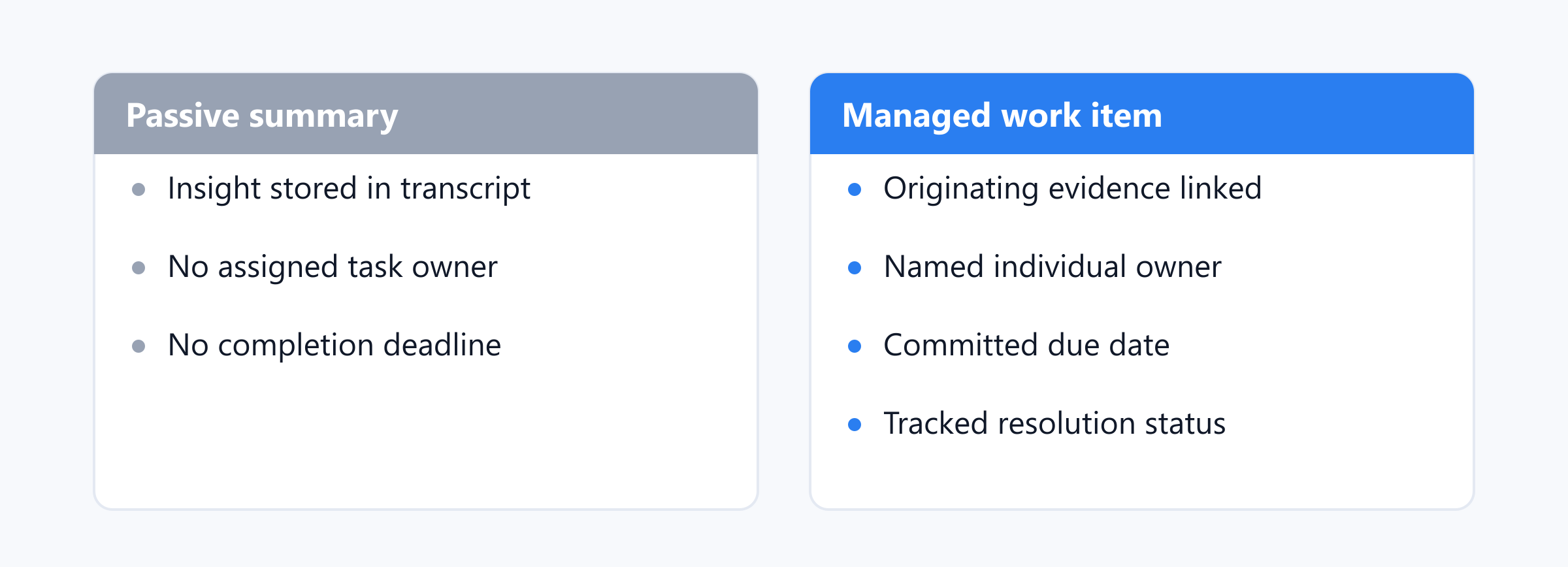
A summary line is not follow-through.
In Contexro, AI-extracted and manual Work Items can start from the analysis, a transcript line, a timestamped key moment, the call header, or an analysis section. Each item can link back to the originating call moment.
A Work Item supports an assignee, due date, priority, tags, comments, attachments, and history. Statuses include Open, In Progress, Pending Review, Waiting on Customer, Waiting on Internal, On Hold, Completed, and Cancelled.
An AI Review queue lets a person validate extracted items before the team relies on them. Board, list, and My Items views manage the queue, while dashboards and digests surface overdue and due-today work.
This matters during handoffs. A price objection can go to enablement, a support failure can go to an escalation owner, and a churn-risk signal can become a CS follow-up with a due date.
Make the vendor complete the loop.
During the demo, select a flagged call moment, create the task, assign it, change its status, complete it, and find it again in a manager or executive view.
For a side-by-side view of this workflow test, see how Contexro compares.
Evaluation area 3: configure analysis for the departments and risks you manage
Generic topics do not tell RevOps whether the rep captured budget, timeline, decision-maker, or resolution state.
Contexro supports department-defined custom metrics and up to 25 company-configurable business checkpoints. Semantic matching uses your written descriptions, captures detected values, and attaches evidence timestamps where available.
Checkpoint results can be filtered in the calls list. This gives an operator a direct way to find calls where the required value was captured or missed.
Objections are typed as price, competition, feature, timing, or trust. Handling is evaluated as addressed well, addressed poorly, or ignored, with resolution status available for review.
Competitor mentions include the surrounding context and sentiment framing. Trend dashboards can group those mentions by period and department.
For the next step from detection to rep guidance, see How Contexro Helps Teams Build Objection Handling Scripts That Reps Use. Discovery teams can apply the same principle through What Are the 7 Steps of a Sales Call? Make Discovery Measurable.
Notifications can surface objection spikes, new competitor appearances, department score drops, red-flag rollups, and low-score clusters. Detection does not assign responsibility by itself. A person reviews the evidence and creates or assigns the Work Item.
Give each vendor three real calls and a written definition for one checkpoint, one objection category, and one escalation condition. Compare the extracted value, supporting evidence, and path into reporting and follow-up.
A practical Gong vs. Contexro pilot scorecard for RevOps
Use your calls, not canned demos.
Include representative calls from every department that will use the platform. The Conversation Intelligence Software Buyer's Guide for 2026 can help define the wider procurement requirements, but the following scorecard tests this workflow directly.
| Check | What good looks like |
|---|---|
| Evidence retrieval | An operator can move from a business question to the relevant speaker-labeled, timestamped evidence without scrubbing the full recording. |
| Separate evaluation | The same call can show a strong rep technique result and a weak business outcome, or the reverse, with evidence for both. |
| Configuration | Your written checkpoint, scoring definition, question coverage, and objection category produce results that an operator can verify. |
| Execution | A call finding becomes a Work Item with an owner, due date, priority, status, comments, and a route back to the source moment. |
| Governance | Managers see the correct reporting tree, while roles and API access keep users within the company and team scope they should have. |
| Operational fit | The tested plan supports your call sources, ingestion method, export needs, access model, implementation capacity, and commercial terms. |
Validate the supported ingestion paths against your stack: call sync from Freshcaller, RingCentral, HubSpot, and Talkdesk, plus manual and bulk upload.
Embedded SSO lets your application sign already-provisioned users into Contexro inside an iframe. Treat it as that specific partner JWT embed pattern, not SAML, OIDC, Okta, or Azure AD federation.
For warehouse access, pull integration call records through the export API into the job you already run. The full export view adds transcript segments and selected analysis fields such as Agent Score, sentiment, and summary. It does not include every field visible in the application.
Test access with real reporting relationships. Available controls include default and custom roles, manager views for direct and indirect reports, and API-enforced scoping across dashboards, calls, customers, tasks, and digests.
Validate Gong's current integrations, exports, scoring configuration, task workflow, access controls, implementation requirements, pricing, contract terms, and support directly with Gong. Do not infer availability from a feature name or an old comparison page.
Do not crown a universal winner. Record what each vendor proves against your calls and operating requirements.
When Contexro is the better fit
The recommendation is direct when your operating model requires all four conditions below.
- Separate outcomes from technique. RevOps needs a Business Score for customer experience, resolution effectiveness, churn risk, or deal impact alongside a distinct Agent Score.
- Give findings an owner. Call evidence must become Work Items with due dates, statuses, comments, history, and links back to the source.
- Run different departmental evaluations. Sales, Support, and CS need separate Agent Score profiles, question coverage, custom metrics, and operational views.
- Coach after every analyzed call. Reps need two or three specific tips with transcript evidence in the dashboard and by email, rather than quarterly coaching roulette.
If your priority is a broader revenue platform, validate the exact Gong modules you plan to deploy against the same scorecard. Require the demo to show your workflow, your access model, and your handoff into completed work.
See how Contexro scores a call, surfaces the evidence, and turns the next step into an owned Work Item.