How Contexro Turns a Sales Call Coaching Template Into Rep Behavior Change
Table of contents
- Copyable sales call coaching template: the checklist
- Call details
- Scoring scale
- Dimension one: call-handling technique
- Dimension two: customer experience and deal impact
- Coaching diagnosis and follow-through
- Score the call in two dimensions before coaching it
- What to score in the four call-handling sections
- Communication
- Listening and discovery
- Objection handling
- Commercial execution
- Run the 20-minute coaching session
- Use objection and checkpoint patterns to choose the next topic
- Why a manual template strains at full call coverage
- Apply the template across analyzed calls with Contexro
- What to do next
A sales call coaching template changes rep behavior only when it separates call technique from deal impact and narrows the review to one behavior the manager can hear. The agreed change then needs an owner, a due date, and inspection on later calls.
Score two dimensions. Coach one behavior. Track the follow-through.
Copyable sales call coaching template: the checklist
Use this sales call coaching rubric as a practical starting point for SDR and AE reviews. It is a coaching diagnosis tool, not a compensation input or a universal verdict on rep ability.
The base criteria suit discovery, qualification, demo, proposal, and negotiation calls. Adapt them to the call stage. A cold outbound conversation might not require budget capture, while a renewal-risk call may need explicit churn-risk handling. Mark a criterion N/A when it does not belong in the call objective. Do not turn N/A into a zero.
Call details
| Field | Entry |
|---|---|
| Rep | ____________________ |
| Manager or reviewer | ____________________ |
| Call type and stage | ____________________ |
| Customer or prospect | ____________________ |
| Call objective | ____________________ |
| Date | ____________________ |
| Recording link | ____________________ |
| Rubric version | ____________________ |
Scoring scale
Apply the same 0-2 definition to every applicable criterion. Record the evidence before choosing the score.
| Score | Definition |
|---|---|
| 0 | Absent or harmful. The behavior did not happen, contradicted the call objective, or made the conversation harder for the buyer. |
| 1 | Present but inconsistent or incomplete. The rep attempted the behavior but missed part of it, applied it at the wrong moment, or failed to confirm its effect. |
| 2 | Clear, effective, and appropriate to the call context. The behavior can be heard in the recording and supports the stated call objective. |
Dimension one: call-handling technique
| Section | Criterion | Observable evidence | Score 0-2 | Timestamp |
|---|---|---|---|---|
| Communication | Clarity | The rep explains the issue, product, or process in plain language. The buyer does not have to ask for the same explanation again. | ___ | ___ |
| Communication | Agenda setting | The rep names the purpose and checks agreement, such as: 'I would like to understand your current process, then decide whether a technical session makes sense. Does that work?' | ___ | ___ |
| Communication | Concise delivery and pacing | The rep explains a point, pauses, and invites a response. Long monologues do not prevent the buyer from contributing. | ___ | ___ |
| Listening and discovery | Relevant follow-up questions | The next question uses the buyer's previous answer instead of jumping to a fixed script. For example: 'You said approvals take six weeks. Which team owns that review?' | ___ | ___ |
| Listening and discovery | Confirmation of the situation | The rep paraphrases the business problem, and the buyer confirms or corrects it. | ___ | ___ |
| Listening and discovery | Business checkpoints | The rep captures budget, timeline, decision-maker, or other configured values when they are relevant to the stage. The reviewer records N/A with a reason when they are not. | ___ | ___ |
| Objection handling | Type and understanding | The rep identifies whether the concern is about price, competition, feature fit, timing, trust, or another issue, then tests the interpretation before responding. | ___ | ___ |
| Objection handling | Response quality | The answer addresses the buyer's stated concern rather than delivering a generic rebuttal. Evidence includes a relevant explanation, question, or agreed follow-up. | ___ | ___ |
| Objection handling | Resolution status | The rep confirms whether the objection was resolved, deferred with a clear action, or left open. The status is heard on the call rather than assumed afterward. | ___ | ___ |
| Commercial execution | Value connected to need | The rep ties value to a problem the buyer actually named, such as reducing manual handoffs after the buyer described delayed follow-up. | ___ | ___ |
| Commercial execution | Mutual next step | Both sides agree on what happens next. A vague promise to reconnect does not pass this check. | ___ | ___ |
| Commercial execution | Owner and timing | The next step has a named owner and confirmed timing, such as the buyer sending security requirements by Friday and the rep returning answers on Monday. | ___ | ___ |
Record four section scores, each out of 6, rather than hiding them inside one average: communication ___ / 6, listening and discovery ___ / 6, objection handling ___ / 6, and commercial execution ___ / 6. Flag any zero that materially affected the call.
Dimension two: customer experience and deal impact
Score this dimension independently. Do not add it to the technique score.
| Criterion | Observable evidence | Score 0-2 | Timestamp |
|---|---|---|---|
| Customer experience | The buyer receives a clear and relevant conversation, can correct misunderstandings, and knows what will happen after the call. | ___ | ___ |
| Resolution effectiveness | The buyer's stated issue is resolved, accurately deferred with an owner and date, or explicitly left open. A polished answer without confirmation is incomplete. | ___ | ___ |
| Churn-risk handling, where relevant | The rep surfaces and addresses the stated retention risk instead of relying on positive tone. Mark N/A when churn risk is outside the call context. | ___ | ___ |
| Deal impact | The call creates supported progress, exposes a real blocker, or establishes that the deal is not a fit. A calendar invitation alone does not establish positive impact. | ___ | ___ |
Coaching diagnosis and follow-through
| Field | Required entry |
|---|---|
| Technique classification | High or low for this call, with the material criteria and context that support the decision. Do not use a universal numeric threshold. |
| Outcome classification | High or low for this call, supported by customer experience and deal evidence. |
| One strength to repeat | One observable behavior, with a timestamp. |
| One behavior to change | One behavior the rep controls. Avoid labels such as 'improve discovery.' |
| Timestamped evidence | One or two moments showing the current pattern. |
| Rep self-assessment | What worked, where the buyer advanced or disengaged, and what the rep would redo. |
| If/then replacement behavior | 'If the buyer raises ___, then I will ask or say ___.' |
| Practice commitment | The specific role-play, call behavior, or preparation step the rep will complete. |
| Owner | ____________________ |
| Due date | ____________________ |
| Next calls to review | List the call type, review window, and recording links when available. |
| Validation test | State what the manager must hear on later calls. Record observed, not yet observed, or needs another call. |
Fictional example: On an AE discovery call, the buyer says implementation cannot start until a security review next quarter. The rep says 'no problem' and returns to the demo. The rep notices the timing concern but does not test what the security review requires, so type and understanding earns 1 out of 2 while resolution status earns 0 out of 2.
The coaching behavior is smaller than 'handle timing better.' If a buyer delays for an internal review, the rep will ask who owns that review, what evidence they need, and when it can be discussed again. The manager assigns that practice, sets a due date, and checks the same behavior on the next calls containing timing objections.
Contexro can start from a custom template and tune each criterion and weight to this standard. Start free: 1 track line, 199 minutes, 1 month. No credit card required.
Score the call in two dimensions before coaching it
Smooth is not enough.
A rep can explain pricing clearly, acknowledge the objection, and keep an appropriate pace while the buyer still leaves without a resolved concern or credible next step. That is strong technique with weak deal impact. Another rep may stumble through discovery but secure a meeting because the buyer has an urgent project. That is a fragile win, not proof that the technique should be repeated.
| Technique and outcome | Coaching response |
|---|---|
| High technique, high outcome | Reinforce the specific behavior that worked and look for it on later calls. |
| Low technique, high outcome | Treat the result as fragile. Identify what depended on buyer urgency, prior intent, or another factor outside the rep's handling. |
| High technique, low outcome | Check qualification, unresolved objections, next-step quality, and deal reality. Do not coach presentation polish when the missing issue is commercial. |
| Low technique, low outcome | Intervene on the smallest behavior tied to the clearest gap, then inspect it on subsequent calls. |
These classifications are coaching judgments, not universal causal claims about revenue. Use the call objective, sales stage, and evidence in the recording. A discovery call can have a productive outcome because it exposes a no-fit decision early.
Do not average away a material weakness. A strong opener cannot cancel missing discovery, and a booked follow-up cannot erase an unresolved price objection.
What to score in the four call-handling sections
The template becomes useful only when two reviewers can point to the same part of the recording and explain why it matters. Each section needs audible evidence.
Communication
Listen for a stated agenda, plain explanations, appropriate pacing, and room for dialogue. A long rep monologue is worth investigating when it prevents the buyer from answering or correcting an assumption.
Talk/listen ratio, silence, and longest monologue are diagnostic signals. They are not standalone verdicts, and there is no universal ratio that proves a call was good or bad. A technical demo and a discovery call demand different patterns.
Listening and discovery
Check whether follow-up questions use the buyer's previous answer and whether the rep confirms what they heard. 'So the delay is caused by legal review, not technical implementation. Is that right?' is stronger evidence than a generic note saying the rep showed active listening.
Budget, timeline, and decision-maker are configurable checkpoints, not mandatory questions for every conversation. Define where each belongs in your process. For stage-by-stage discovery detail, use What Are the 7 Steps of a Sales Call? Make Discovery Measurable rather than forcing every checkpoint into the first call.
Objection handling
Record the objection type, whether the rep tested their understanding, what response they gave, and what happened next. 'That sounds like a timing concern. Is the constraint budget approval or implementation capacity?' creates evidence. A note saying 'handled objection well' does not.
Resolution status matters. An objection can be resolved, deferred with an assigned follow-up, or left open. The rep should not receive full credit because they spoke confidently while the buyer remained unconvinced.
Commercial execution
Listen for value tied to the buyer's stated need, followed by a mutual next step with an owner and timing. 'I will send the security package' is incomplete. 'I will send it by Thursday, and Jordan will confirm whether security can join next Tuesday' can be checked later.
Run the 20-minute coaching session
One behavior.
A 20-minute session is a recommended operating cadence, not a research-backed universal optimum. The time limit forces the manager to choose the issue that deserves practice rather than reading every red cell aloud.
- Prepare before the meeting. Choose one call and preselect one or two timestamped moments that show the pattern. Do not spend the session reviewing the recording from the beginning.
- Start with rep self-assessment. Ask what worked, where the buyer advanced or disengaged, and what the rep would redo. Keep the questions tied to the call.
- Compare views using evidence. Put the rep's assessment beside the technique and outcome scores. Select one priority gap, even if the rubric contains several imperfect scores.
- Write the replacement behavior. Have the rep state it in an if/then format. For example: 'If the buyer says the price is too high, then I will ask which cost or expected return they are comparing it with before responding.'
- Role-play the actual moment. Run the objection once or twice using the buyer's real wording and account context. Stop when the rep demonstrates the agreed behavior, not when the role-play becomes a new discovery meeting.
- Assign the follow-through. Create a written task with an owner, due date, and defined window for reviewing the next calls where that behavior should appear.
A completed coaching session records activity. Changed behavior on later calls shows whether coaching reached the call.
Use objection and checkpoint patterns to choose the next topic
One call can reveal a problem. It cannot establish how often that problem occurs or prove why performance changed.
Group repeated objections by type, including price, competition, feature, timing, and trust. Then inspect handling quality and resolution status by rep. For discovery gaps, check whether budget, timeline, decision-maker, or another configured checkpoint is repeatedly missing before declaring that the rep has weak discovery.
| Observed pattern | What to verify | Small behavior to coach |
|---|---|---|
| Timing objections are repeatedly left open | Did the rep identify the event or dependency behind the delay? | Ask what must happen before the buyer can proceed, who owns it, and when it will be reviewed. |
| Price objections receive immediate discounts or long explanations | Did the rep ask what the buyer was comparing and which outcome justified the spend? | Ask one comparison question before presenting a response. |
| Budget is repeatedly absent from applicable discovery calls | Was budget relevant at that stage, and did the prospect volunteer a value? | Ask how similar purchases are funded and when budget is set. |
| Decision-maker information is missing | Did the rep explore the approval process rather than demand a job title? | Ask who needs to review the decision and what each person evaluates. |
| Competition objections are deferred without ownership | Did the rep identify the capability or risk driving the comparison? | Confirm the comparison point and assign a dated follow-up. |
Compare a rep with their own recent calls first. That shows whether the behavior is changing within a comparable call mix. Team comparisons can then identify a practice worth borrowing, but neither view proves the cause of a deal result.
For the deeper reason aggregate scores conceal operational gaps, read Your sales call scorecard is averaging away the thing you need to see.
Why a manual template strains at full call coverage
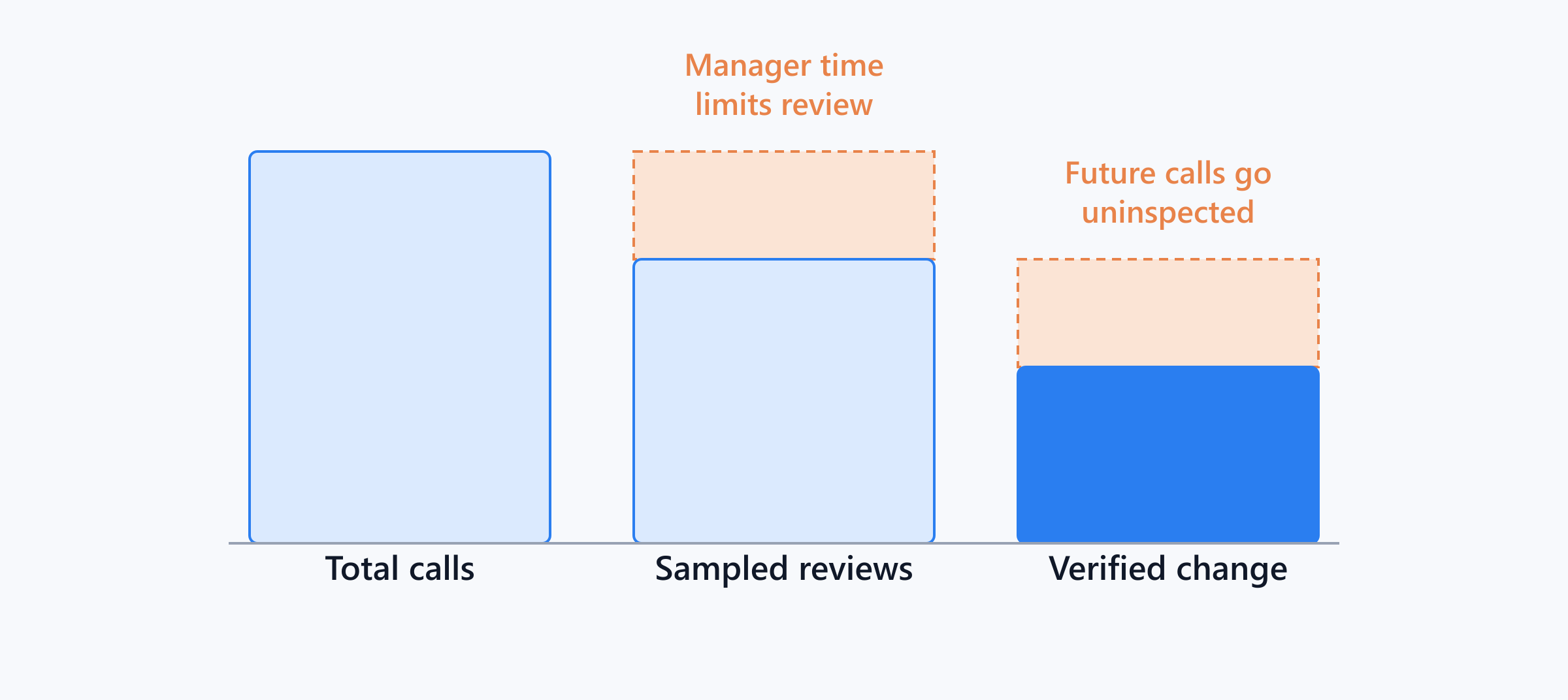
A manual call review template can create consistent reviews for selected calls. Extending the same process across all configured calls creates a recurring chain of work: find the right recording, scrub for the relevant moment, distinguish speakers, score each criterion, write feedback, send it to the rep, create the task, monitor the due date, find later calls with the same objection, and decide whether the new behavior appeared. Some teams may choose to do all of that manually. The trade-off is that manager judgment gets spent on evidence collection and administration before the coaching conversation starts.
Sampling decides what gets coached.
A manager may review the polished demo while missing three other calls where timing objections remained open. They may coach missing budget capture without seeing that prospects volunteered budget elsewhere in the week. The template remains the shared standard, but automation is what applies evidence collection and follow-through at call volume.
Automation should not replace manager judgment. It should reduce call scrubbing, expose the evidence behind a score, and make the manager's chosen behavior easier to inspect again.
Apply the template across analyzed calls with Contexro
Contexro starts from MEDDIC, SPICED, or a custom template, then lets the team tune criteria and weights. Separate scorecards are available for Sales, Support, and CS, so a discovery checkpoint does not get forced onto a different call type.
Contexro puts speaker-labeled, timestamped transcripts with confidence scores beside timestamped key moments linked to the recording. A manager can open the evidence behind a score instead of scrubbing the entire call.
Contexro evaluates communication, listening, objection handling, and commercial execution, with AI reasoning on each score. Customer experience, resolution effectiveness, churn risk, and deal impact remain in an independent outcome metric, separate from how polished the rep sounded.
| Template requirement | How the workflow handles it |
|---|---|
| Observable call evidence | Speaker-labeled transcripts and timestamped key moments link each finding to the recording. |
| Communication signals | Talk/listen ratio, silence, longest monologue, and sentiment trend surface moments that deserve inspection without treating a metric as proof. |
| Discovery checkpoints | Auto topics and company-configurable checkpoints capture values such as budget, timeline, and decision-maker. The system flags which checkpoints were missed and whether the prospect volunteered the information. |
| Objection evidence | Typed objections cover price, competition, feature, timing, and trust, with handling quality and resolution status scored across reps. |
| One behavior to improve | After each analyzed call, reps receive two or three specific tips in their dashboard and by email within minutes, subject to rep quiet hours. |
| Assigned practice | AI-extracted and manual Work Items support owners, due dates, priorities, comments, board and list views, and dashboard visibility. |
| Later-call validation | Versioned scoring history, phrase mining by stage, an objection-handling library, and rep benchmark comparisons support cross-call review. |
| Manager follow-through | Executive and team views include score distributions and heatmaps. Manager-scoped daily or weekly digests surface due-today and overdue Work Items. |
After every analyzed call, Contexro surfaces the ratios, silence, monologue length, auto topics, configured checkpoint values, and typed objections behind the review. Those signals tell the manager where to listen. They do not prove why a deal advanced or stalled.
Contexro turns call insights into assigned Work Items with owners and due dates, then keeps them visible in dashboards and manager-scoped digests. Versioned scoring history and team views let the manager return to the agreed behavior on later calls instead of treating the completed 1:1 as progress.
What to do next
Copy the embedded sales coaching checklist and use it in the next call review. Score technique and outcome separately, select one timestamped behavior, write the if/then replacement, assign the task, and define which later calls will validate it.
If the standard works but evidence collection and task follow-through do not scale, use Contexro to apply the same scorecard, evidence, feedback, and Work Items workflow after analyzed calls.