How Contexro Finds the Inventory Questions Costing Your BDC Appointments
Table of contents
- The BDC problem is not just missed calls, it is unanswered buying questions
- Why spot-checking BDC calls hides the pattern
- Run an Inventory-Question Leakage Audit across every inbound call
- What Contexro surfaces after each analyzed BDC call
- Turn the audit into a weekly BDC operating rhythm
- What to do next
An answered phone does not mean an answered buying question. Contexro finds inbound calls where inventory, price, payment, or trade questions were missed or left unresolved, then puts those calls beside missed, voicemail, and unfollowed cases so managers can recover the opportunity.
The point is not to assume every incomplete answer loses an appointment. It is to find the high-risk calls before they disappear inside call volume.
The BDC problem is not just missed calls, it is unanswered buying questions
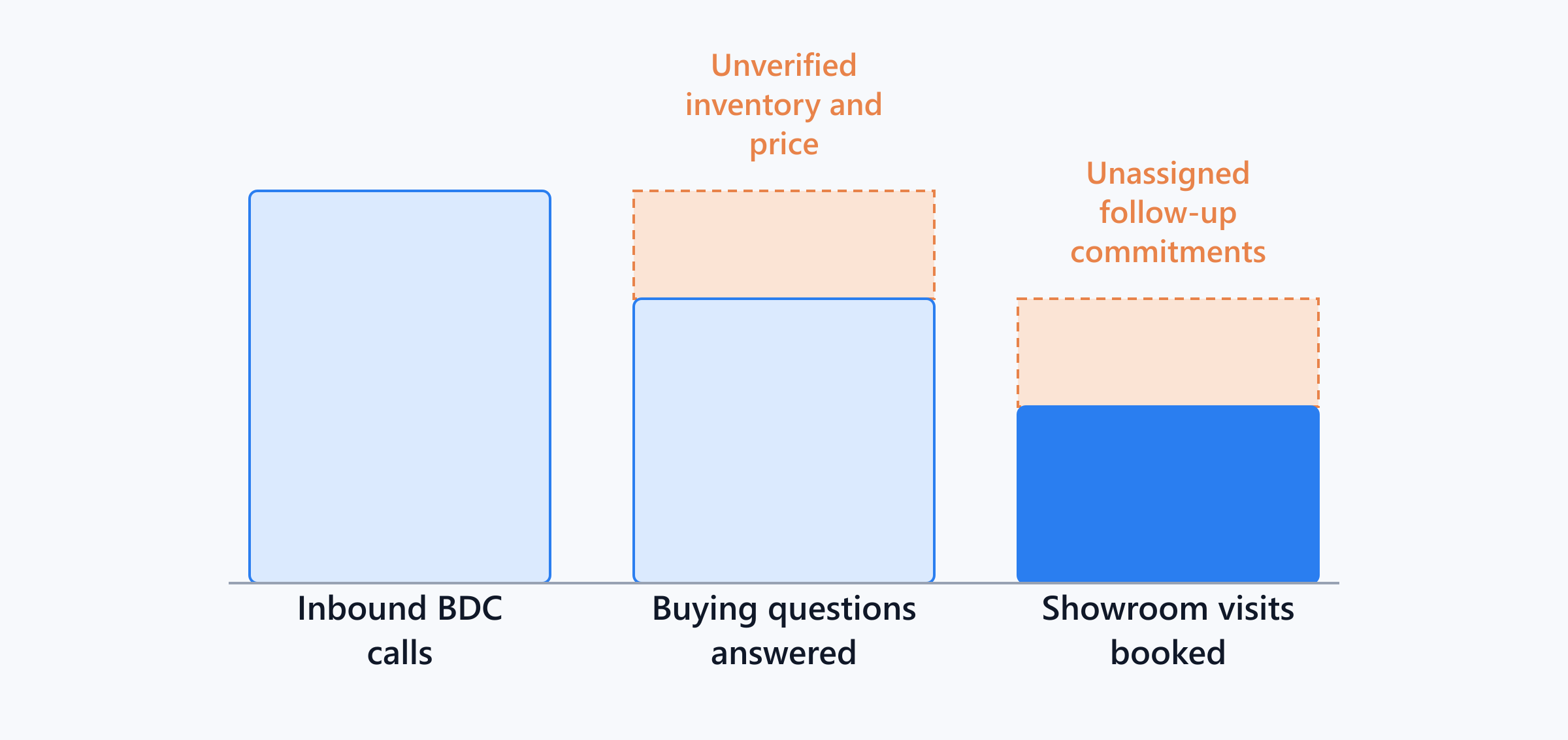
A shopper asks whether a specific VIN is still available. The agent says, 'It should be,' moves into a general vehicle description, and never confirms who will check.
Another caller wants the out-the-door price before driving across town. The agent explains that pricing depends on several factors but does not capture the requested stock number, offer an escalation path, or set a callback expectation.
The same problem appears around requested packages, payment ranges, trade expectations, and the earliest time a vehicle can be seen. These are appointment-blocking questions when the shopper needs an answer or credible next step before committing to a visit.
| Inbound call state | What management needs to inspect |
|---|---|
| Missed call | Whether the call reached the intended line or agent, why it was missed, and who owns the response. |
| Inbound voicemail | What the shopper requested and whether a later connected follow-up occurred. |
| Answered, question missed | Whether the shopper asked about availability, trim, price, payment, trade, or timing without the required detail being captured or addressed. |
| Answered, incomplete response | Whether the agent acknowledged uncertainty, named the person who could verify the answer, and established a credible next step. |
| Answered, resolved | Whether the requested information was provided or the follow-up commitment had a clear owner and expectation. |
A missed call and an answered-but-unresolved call are different failures. They belong in the same operating view because neither shopper received the information needed to move forward.
The real pass/fail test is not whether the agent sounded helpful. It is whether the shopper left with the requested answer or a named owner, promised detail, and next step.
Build the dealership's list from its own BDC scripts, recordings, and lead-handling rules. One store may require stock number, desired trim, trade status, and visit timing. Another may use a different escalation sequence. Do not turn one dealership's process into a universal standard.
Why spot-checking BDC calls hides the pattern
A manager can listen to a few calls and still miss the failure chain. Inventory questions may be scattered across agents, tracked lines, shifts, and weeks, while voicemail and unfollowed inbound cases sit outside the usual coaching sample.
This is an operational limit, not an argument about a universal QA sample size. Review how your dealership currently selects calls, how inbound lines route, and whether missed and voicemail cases enter the same management queue as answered calls.
Polish also distorts manual review. A friendly agent can maintain a clean talk track while failing to record the requested VIN, answer the price question, or advance the caller toward an appointment.
A useful review queue needs several signals:
- Reachability. Separate answered, missed, voicemail, skipped, and unfollowed inbound cases.
- Question coverage. Filter by topic and by whether required values such as stock number, trim, budget, or timing were captured.
- Call result. Review the stated outcome, red flags, Business Score, and Agent Score without treating them as the same measure.
- Follow-up ownership. Show open and overdue Work Items beside the call that created them.
Dealership call tracking can tell you that a connection happened. A conversation intelligence platform should show whether the buying question was covered, what the agent committed to, and whether someone owns the next step.
Run an Inventory-Question Leakage Audit across every inbound call
Run the audit across the full set of imported inbound calls, not a curated playlist. Before starting, document who can verify availability, price, payment, and trade details when the auto BDC cannot answer immediately.
- Establish the inbound universe. Review answered, missed, voicemail, skipped, and unfollowed inbound calls by tracked line, agent, and week. This places silent drop-offs beside calls where a conversation occurred.
- Define the question library. Contexro supports a cross-call question library and up to 25 company-configurable checkpoints. Describe the dealership's required questions in its own language, including vehicle availability, VIN or stock number, trim and features, price or payment, trade, timing, and decision-maker involvement.
- Test coverage and answer quality. Filter for calls where a configured value was not captured. The analysis identifies which configured questions were missed and attaches evidence timestamps where values are available, allowing a manager to inspect the exact exchange rather than infer quality from a summary.
- Compare technique with outcome. Agent Score assesses technique across six rubric dimensions, including clarity, listening, and commercial execution, with transcript evidence behind the judgment. Business Score independently assesses customer experience, resolution effectiveness, churn risk, and deal impact. A rep may explain the pricing process clearly while still leaving the shopper without a promised payment estimate or callback owner.
- Recover the opportunity. Turn the promised inventory check, payment detail, or trade response into a Work Item. Assign an owner, due date, priority, and status based on the dealership's escalation process.
- Find repeatable causes. Compare gaps by agent, tracked line, question topic, and week. Repeated misses may point to unclear escalation rules or poor access to information rather than an individual coaching problem.
Question coverage is only useful when the dealership defines what must be captured, answered, or escalated. The software should apply that definition consistently. Leadership still decides whether the answer was factually correct and what recovery action is appropriate.
What Contexro surfaces after each analyzed BDC call
Contexro delivers a structured report after the call is processed. It includes a TL;DR, purpose, outcome, narrative, speaker-labeled transcript, and timestamped key moments, so a manager can jump directly to the inventory or pricing exchange.
Set an Agent Score profile for the BDC and align its question coverage template to the dealership's call guide. Business Score remains independent, using one company-wide definition of a good outcome, so confident delivery cannot hide weak resolution.
The triage path is direct. Filter missed, voicemail, skipped, and unfollowed inbound cases. Then filter answered calls by whether a required checkpoint value was captured, review red flags and low-score clusters, and open the transcript evidence for the calls that need attention.
Price resistance receives a separate treatment. Objection intelligence categorizes a price, timing, feature, competition, or trust objection and shows whether it was handled well, poorly, or ignored. That helps distinguish a shopper requesting price information from one actively objecting to the amount.
Work Items can be created from the analysis, a transcript line, a key moment, the call header, or manually. Each item can carry an owner, due date, priority, tags, comments, attachments, status, and a deep link to the originating call moment.
AI-extracted tasks can enter an AI Review queue before the team trusts them as assigned work. A manager confirms that the agent really promised a callback, checks the owner, and then moves it into the working queue.
Contexro's manager-scoped daily and weekly digests show missed-versus-answered trends, skipped-call reasons, Business Score changes, red flags, top question topics, and overdue or due-today Work Items. Managers can move from the digest into filtered operational queues instead of waiting for quarterly coaching roulette.
The boundary matters. Contexro analyzes available call data and configured checkpoints. It does not verify live inventory, calculate dealer pricing, update a dealer management system, or book an appointment automatically. A person must verify the requested detail and contact the shopper.
Confirm the call source before deployment. Supported ingestion is call sync from Freshcaller, RingCentral, HubSpot, and Talkdesk, plus manual and bulk upload.
Start free: 1 track line, 199 minutes, 1 month. No credit card required.
Turn the audit into a weekly BDC operating rhythm
The audit should become a recovery and coaching routine, not another dashboard tab.
- Daily recovery. Assign callbacks and internal verification work for missed, voicemail, unfollowed, and high-risk answered calls. Use the dealership's approved service level rather than copying an unsupported industry benchmark.
- Weekly review. Examine the most common unanswered question categories, calls missing required checkpoint values, appointment-related call outcomes, repeat red flags, and overdue Work Items by rep and line.
- Specific coaching. Use the transcript and timestamped moment to coach the behavior that failed. The rep may need to clarify the requested trim, acknowledge uncertainty, state who will verify availability, and take ownership of the response.
- Process correction. If several agents miss the same question, inspect the information source, escalation rule, and call guide before treating the issue as an individual performance failure.
- Leadership tracking. Review directional changes in missed-versus-answered calls, question coverage, Business Score, Agent Score, and completed recovery work. Goals with progress tracking still require manager review.
Contexro also gives reps per-call coaching tips with transcript evidence and shows rep trends to managers. That supports focused coaching on the exact call behavior instead of generic advice such as 'ask better questions' or 'create more urgency.'
Keep booked and shown appointment truth in the dealership system that already owns it. Call analysis shows what happened in the available conversation data; it does not replace the dealership's appointment source of truth.
What to do next
Start with one tracked inbound line and one week of calls. Approve the appointment-critical question library, name the escalation owner for each question type, and review every case where the answer or follow-up owner was missing.
Then repeat the audit by rep, line, topic, and week. Recover the open opportunities first. Use the repeated patterns to decide what needs coaching and what needs a process fix.
A walkthrough can show how Contexro surfaces unanswered inventory questions, missed inbound calls, and overdue follow-up work across your BDC call volume.