
How Contexro Turns Insurance Quote Commitments Into Owned Follow-Ups
Table of contents
- Forgotten quote follow-ups are an execution problem, not a note-taking problem
- First, define what counts as a quote commitment
- Convert the call into a follow-up the team can trust
- Run the follow-up queue before opportunities go silent
- Separate a weak outcome from a weak call
- Make follow-up review a manager cadence, not a rescue exercise
A producer promises a revised quote, the call ends, and no owner or deadline appears anywhere the team manages work. The fix is a reviewed Work Item workflow that keeps the commitment visible until someone completes it or deliberately closes it.
Contexro turns AI-extracted actions from analyzed calls into Work Items with an assignee, due date, status, and link to the call evidence. Detection starts the process. A person remains accountable for validating and completing the follow-up.
Forgotten quote follow-ups are an execution problem, not a note-taking problem
A prospect asks for higher liability limits and a lower deductible option. The producer promises to send both versions after checking with the carrier.
The summary records the promise. The recording preserves it. Neither creates accountability unless the commitment enters a queue with an owner and due date.
A follow-up is not controlled because the promise appears in a transcript. It is controlled when the team can see who owns it, when it is due, and why it remains open.
This is where conversation intelligence solutions either become useful or become another archive. Summaries help people understand what happened. Managed work determines what happens next.
The issue extends beyond one revised quote. Initial proposals, underwriting updates, missing driver information, renewal-timing check-ins, and callbacks after inbound contact can all disappear into an inbox or personal reminder.
First, define what counts as a quote commitment
Do not ask AI or managers to find every possible follow-up until the agency has defined what deserves one. A quote commitment is a stated or necessary customer-facing next action tied to moving the opportunity toward a decision.
| Commitment type | What creates the follow-up | What the item should record |
|---|---|---|
| Initial quote | The producer agrees to prepare and send coverage options. | The prospect, promised quote, owner, due date, and supporting call moment. |
| Quote revision | The prospect requests different limits, deductibles, drivers, vehicles, properties, or coverage. | The requested change and who must return the revised option. |
| Missing information | Quoting cannot continue until the agency receives or verifies required information. | What is missing, who will request it, and when the request should happen. |
| Carrier or underwriting update | The producer promises to return with eligibility, pricing, or underwriting information. | The open question and the person responsible for reporting back. |
| Decision check-in | The prospect expects a follow-up after reviewing the quote or speaking with another decision-maker. | The agreed timing and purpose of the next contact. |
| Return contact | An inbound call or voicemail requires a response. | The callback owner, due date, and originating contact evidence. |
Not every mention of coverage or pricing deserves a task. A discussion about deductibles is a topic. A promise to send a second deductible option is a commitment.
Contexro supports up to 25 company-configurable checkpoints. An agency could define examples such as next step, budget, timeline, decision-maker, requested revision, or missing information, then use semantic matching to capture values and evidence timestamps where available.
Those examples are agency-defined. They are not prebuilt insurance templates, and extraction still requires clear instructions and human review.
The checkpoint logic also helps managers inspect discovery quality. What Are the 7 Steps of a Sales Call? Make Discovery Measurable explains the broader method for turning expected questions and next steps into evidence that can be reviewed.
Convert the call into a follow-up the team can trust
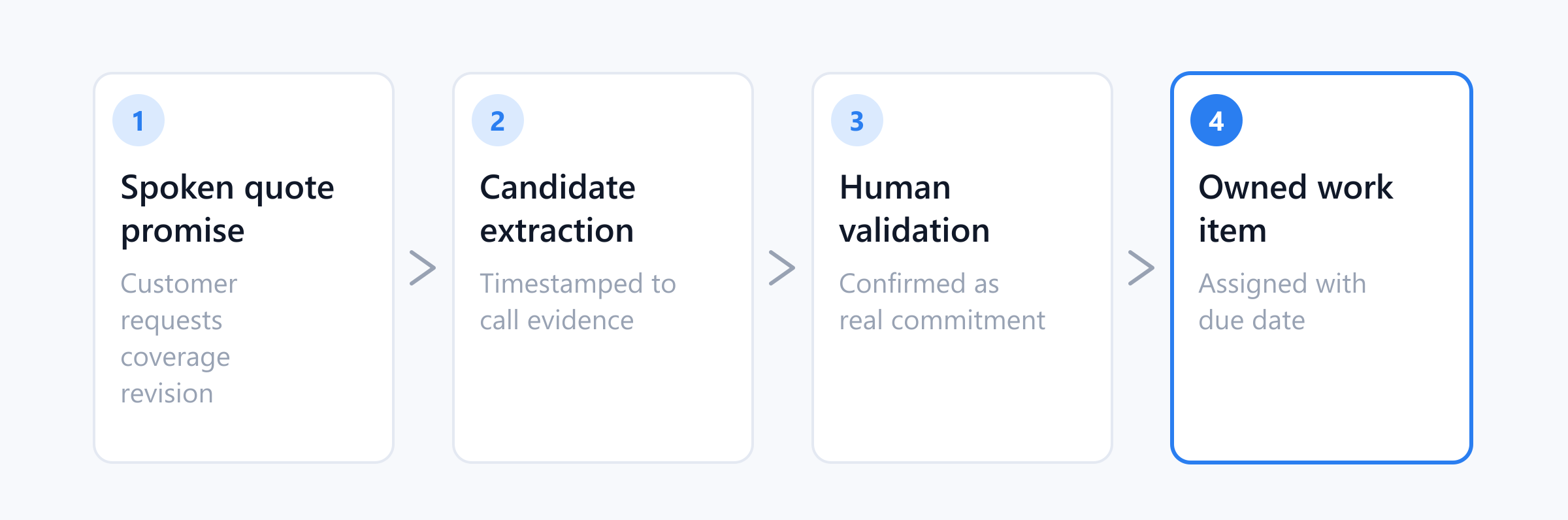
After a call is processed, Contexro produces a TL;DR, a structured summary covering purpose and outcome, AI-extracted action items, and timestamped key moments. The producer or reviewer can jump directly to the point where the revised quote, callback, or underwriting update was promised.
The next step matters more than the extraction itself. Candidate actions enter the AI Review queue so a person can confirm that the commitment is real, correct the details, and reject items that do not belong in the trusted queue.
- Locate the promise. Start with the TL;DR, structured summary, action items, and key moments instead of scrubbing the full recording.
- Validate the action. Confirm what was promised, which customer it affects, and whether a customer-facing next step is actually required.
- Assign the work. Create or approve a Work Item with an assignee, due date, priority, and relevant tags.
- Set the real status. Use Open, In Progress, Pending Review, Waiting on Customer, Waiting on Internal, On Hold, Completed, or Cancelled to show what is happening now.
- Preserve the evidence. Keep the deep link to the originating call moment so the owner can hear the commitment in context.
Work Items also support comments, mentions, attachments, and history. That gives the producer, account manager, or agency owner one place to record why a quote is waiting and what needs to happen next.
A task is not complete because AI extracted it. It is complete when the owner sends the promised quote, makes the callback, provides the update, or closes the item with context explaining why the commitment no longer applies.
See how Contexro turns validated follow-up actions from analyzed calls into Work Items with owners, due dates, statuses, and a direct link back to the moment the commitment was made.
Run the follow-up queue before opportunities go silent
Producers should start with My Items, then use board or list views to work due-today and overdue commitments. Searching through recordings should be the exception because the Work Item already links back to the relevant call moment.
Managers can see overdue and due-today Work Items on the dashboard and in executive digests. The review is concrete: confirm the current assignee, inspect the status, and decide whether work waiting on a customer or internal stakeholder needs intervention.
Inbound contact needs its own pass. Contexro flags unfollowed inbound, missed, and voicemail cases, including inbound voicemails with no later connected follow-up. A calls-list filter isolates those cases, and a manager can assign a Work Item from the filtered list.
This is visibility and accountability. It does not place the outbound call for the producer.
How Contexro Finds the Calls Your Home Services Team Missed covers the same missed-contact discipline in an appointment-driven setting. The operating rule carries across industries: surface the unanswered contact, assign the response, and keep it visible.
Handoffs also stop being dependent on one producer's memory. The Customer 360 timeline shows call history, summaries, objections, and linked follow-up context across every rep who spoke with the customer.
If the original producer is unavailable, another team member can see the quote request and the previous commitment before contacting the prospect. Call and customer filters then help managers triage by Business Score category, red flags, contact frequency, or whether configured checkpoints were captured.
Separate a weak outcome from a weak call
A producer can explain coverage clearly, listen carefully, and handle a price objection well, then finish without agreeing on when the revised quote will arrive. The call technique may be strong while the business outcome remains weak because the prospect is still unresolved.
Contexro keeps those judgments separate. Agent Score evaluates call-handling technique across six rubric dimensions, including clarity, listening, objection handling, and commercial execution. Business Score independently evaluates customer experience, resolution effectiveness, churn risk, and deal impact on analyzed calls.
Managers can review transcript evidence behind the scores and inspect per-call coaching insights. A low outcome should send them to the unresolved issue, missing next step, customer sentiment, red flags, and related Work Items before they decide what coaching is needed.
Your sales call scorecard is averaging away the thing you need to see examines why one blended score hides this distinction. A polished producer and an unresolved prospect are two separate management facts.
If the technique is weak, coaching should match the evidence. A producer who never confirms the requested coverage change needs help with listening and commercial execution. A producer who becomes defensive over premium needs a different intervention.
How Contexro Turns a Sales Call Coaching Template Into Rep Behavior Change shows how evidence-backed scoring can become a repeatable coaching process rather than quarterly coaching roulette.
Objection review adds another layer. On an insurance quote call, a premium concern maps to a price objection, an incumbent carrier can represent competition, and waiting until renewal is a timing objection. The platform categorizes price, competition, feature, timing, and trust objections, then records whether each was addressed well, poorly, or ignored and whether it was resolved.
How Contexro Helps Teams Build Objection Handling Scripts That Reps Use covers how managers can turn recurring objection evidence into specific practice. Keep that coaching connected to the Work Item queue. Handling an objection well does not remove the need to send the promised revision.
Make follow-up review a manager cadence, not a rescue exercise
The workflow only holds if producers and managers use it on a schedule.
- Daily producer review. Clear due-today items, update statuses, and flag work waiting on customers, carriers, underwriting, or another internal owner.
- Weekly manager review. Inspect overdue Work Items, unfollowed inbound contacts, low-score clusters, red-flag rollups, and recurring objections that are slowing quote progression.
- Monthly workflow review. Refine the agency's commitment definitions and configured checkpoints based on what repeatedly appears in calls and where follow-up stalls.
Manager-scoped daily and weekly email digests surface overdue and due-today Work Items for each reporting tree. Dashboard and digest links lead back to the operational queues, while assignment, completion, overdue, and mention alerts keep individual items visible.
This cadence moves the manager from an aggregate warning to the exact quote commitment, owner, status, and call evidence. No transcript hunt. No assumption that an unbound policy proves the producer mishandled the call.
Start with one rule: every customer-facing quote promise must become reviewed work with an owner and due date. Then inspect the queue often enough that Waiting on Customer, Waiting on Internal, and overdue items cannot become permanent hiding places.
For the wider revenue pattern beyond insurance quoting, read How Contexro Stops Pipeline Leakage From Forgotten Call Commitments.
Start free: 1 track line, 199 minutes, 1 month. No credit card required.