
How Contexro Stops Pipeline Leakage From Forgotten Call Commitments
Table of contents
- The pipeline leak hiding inside "I'll send that after the call"
- Why CRM notes and sequence tools do not solve commitment tracking
- The Promise-to-Work-Item workflow in Contexro
- How sales leaders prevent promises from becoming overdue surprises
- What to evaluate in sales follow-up tracking software
- Make call promises reviewable before they go quiet
Forgotten call commitments leak pipeline because the promise was recorded, but the work was never owned. Contexro gives teams a review workflow that turns each commitment into a validated Work Item with an owner, due date, and direct link to the call context.
The fix is not another outreach cadence. It is a clear path from spoken promise to visible work.
The pipeline leak hiding inside "I'll send that after the call"
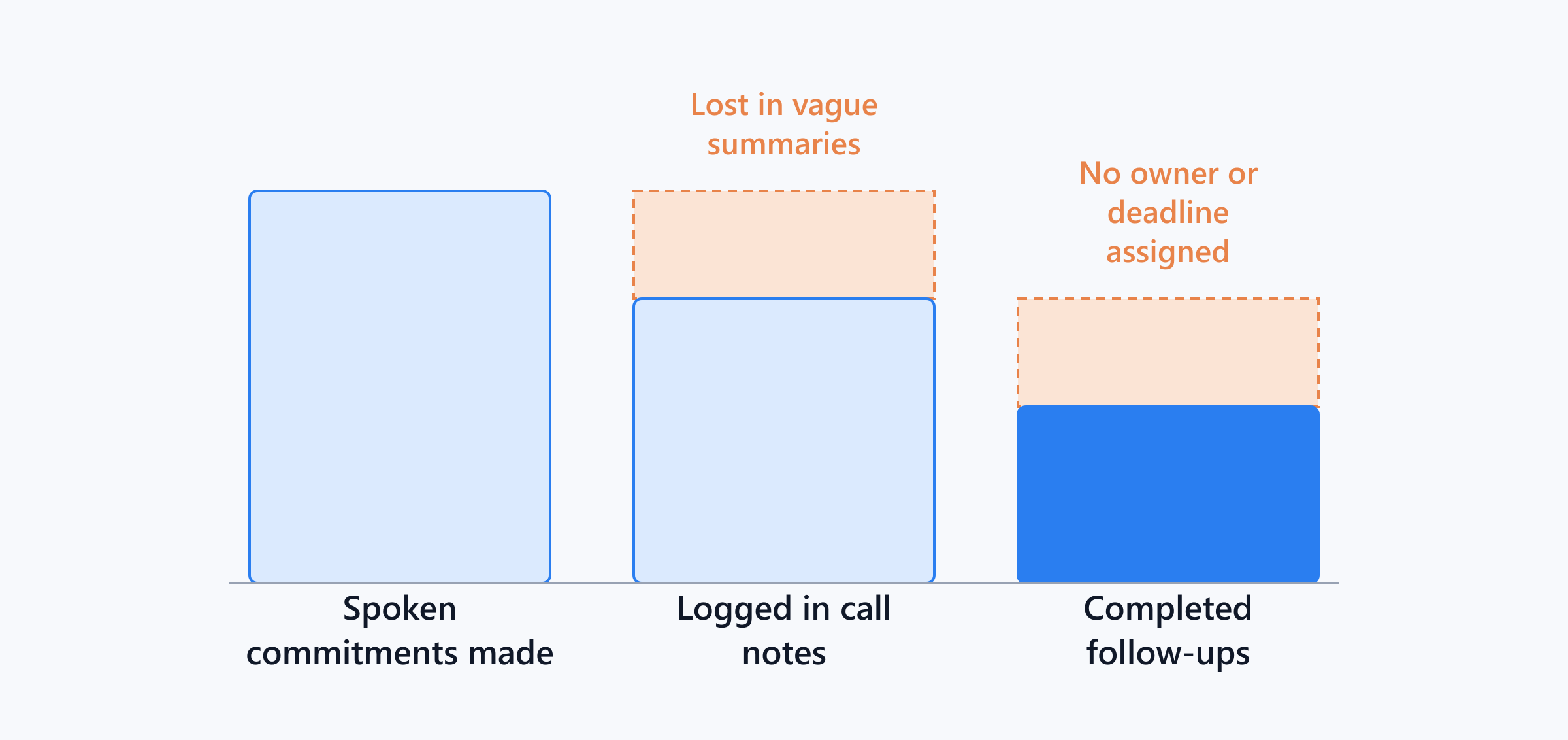
A call commitment is a concrete next action stated during a discovery, demo, or deal-progress call. The rep promises to send pricing. Sales Engineering agrees to book a technical review. The buyer says they will confirm who signs the agreement.
These are specific promises, not generic reminders to "follow up." Each one affects what the buyer expects to happen next.
Consider an illustrative demo call. The buyer asks for security documentation before Friday, and the rep agrees to send it after checking with the security team. The recording contains the promise, but the CRM note only says "positive demo." No owner is assigned, and no deadline is visible.
Friday passes. The buyer has to ask again, the deal appears active even though progress has stopped, and the manager does not see the problem until the next pipeline review.
A promise in a transcript is evidence that work exists. It is not proof that anyone owns it.
Call structure still matters. What Are the 7 Steps of a Sales Call? Make Discovery Measurable explains how to make discovery coverage visible. Commitment tracking starts one step later: once the team says something will happen, who owns making it happen?
The same accountability gap can appear before a connected conversation. How Contexro Finds the Calls Your Home Services Team Missed shows how unfollowed inbound voicemails can be surfaced so a manager can assign the callback. Here, the focus is the promise already made during a completed sales call.
Why CRM notes and sequence tools do not solve commitment tracking
CRM notes, tasks, and sales-engagement sequences can all contribute to follow-up execution. Their presence alone does not establish that a specific promise from a live call became owned work.
| Approach | What it handles well | Where commitments can still disappear |
|---|---|---|
| CRM notes | Recording call summaries, deal details, and next-step context | The note may lack a separate owner, due date, status, or link to the exact call moment unless the rep creates and maintains them |
| Sales-engagement sequences | Scheduling repeated outreach across defined steps | A standard cadence may not represent the specific promise made during the conversation |
| Call-linked Work Items | Tracking the exact commitment as assigned, due-dated work | The process still needs human review, clear ownership, and manager attention to exceptions |
A useful sales follow up tracking record preserves five fields: the commitment, accountable owner, due date, current status, and source context. Some CRM and sales-engagement platforms can support parts of this with the right configuration. The operational test is whether all five stay connected.
Source context matters when ownership changes or the promise is unclear. A new account executive should be able to hear that the buyer requested pricing for a specific deployment plan, rather than interpreting a note that says only "send quote."
If the goal is to track sales call follow ups, recording outreach activity is insufficient. The system must show what was promised and whether anyone completed it.
The Promise-to-Work-Item workflow in Contexro
After a call is processed, Contexro produces an AI-generated TL;DR and structured summary covering the purpose, outcome, and narrative. Action items then feed the Work Items layer, where a person can validate the work and add the accountability fields needed for execution.
- Identify the promise. A Work Item can originate from AI analysis, a transcript line, a timestamped key moment, the call header, an analysis section, or manual creation. This supports both detected commitments and work a rep adds directly.
- Validate the extraction. AI-extracted items enter the AI Review queue so a person can confirm that the item represents real work before the team treats the execution queue as trusted.
- Set accountability. The reviewer assigns an owner and due date, then adds the appropriate priority and tags. This is a workflow step, not a claim that every owner or deadline is inferred automatically.
- Track the current state. Work Item statuses include Open, In Progress, Pending Review, Waiting on Customer, Waiting on Internal, On Hold, Completed, and Cancelled. Comments, mentions, attachments, and history keep the work understandable as it changes.
- Retain the evidence. A deep link returns the assignee to the originating call moment. They can hear the request and surrounding discussion instead of searching a long recording or relying on a compressed note.
Take an illustrative pricing scenario. The rep promises to send a revised proposal on Friday after Legal approves new terms. The reviewer validates the extracted action, assigns the rep, sets Friday as the due date, and marks it Waiting on Internal while Legal reviews the change.
The rep can jump back to the exact call moment before preparing the proposal. Once the internal dependency clears, the item can move to In Progress and then Completed.
The result is precise. A promise becomes visible work, rather than another detail buried in a transcript.
See how Contexro turns call commitments into owned Work Items with due dates, timestamped context, and overdue visibility.
How sales leaders prevent promises from becoming overdue surprises
Creating the Work Item is only the handoff. Leaders still need a routine for finding exceptions before the buyer has to chase the team.
Contexro surfaces overdue and due-today Work Items on the dashboard and in daily or weekly manager-scoped email digests. The digest follows the manager's reporting tree, so leaders can review the work relevant to their teams without auditing every rep's notes.
| View | Best operating use |
|---|---|
| My Items | Individual execution against assigned commitments |
| Board | Team review organized around the current Work Item status |
| List | Scanning and triaging a larger set of commitments |
| Dashboard and digest | Finding due-today and overdue exceptions that need attention |
Visibility is not automatic escalation. The manager still needs to resolve unclear ownership, remove internal blockers, and decide what happens when a commitment becomes overdue.
If several proposal updates sit in Waiting on Internal, the problem may be the approval handoff rather than rep effort. If one rep repeatedly has overdue pricing promises, the manager can inspect those items and the linked call context before deciding what to fix.
Recommended operating rule: Every commitment made on a customer call should be reviewed for ownership and a due date before it disappears into unstructured notes.
Keep this execution review separate from coaching. How Contexro Turns a Sales Call Coaching Template Into Rep Behavior Change explains how per-call coaching insights and transcript evidence address rep behavior. A Work Items review asks a narrower question: did the team fulfill the promise?
Your sales call scorecard is averaging away the thing you need to see covers the measurement problem behind aggregate rep averages. An overdue promise is a named exception with an owner and context, not a small input hidden inside a team score.
What to evaluate in sales follow-up tracking software
Use the following criteria according to your sales process. They are practical tests for whether a platform can prevent missed sales follow ups, rather than universal requirements for every team.
| Check | What good looks like |
|---|---|
| Capture mechanism | Action items can come from call analysis and specific call touchpoints, rather than relying only on manual notes |
| Human validation | A person can review AI-extracted work before it enters the trusted execution queue |
| Accountability fields | Each item can carry an owner, due date, priority, status, comments, and history |
| Source evidence | The assignee can return directly to the originating transcript line or timestamped call moment |
| Leader visibility | Managers can see due-today and overdue items without opening every call or rep note |
| Creation options | The workflow supports both AI-extracted and manually created follow-up work |
Do not confuse Work Item statuses with CRM pipeline stages. Open, Waiting on Customer, and Completed describe the state of the promised work. They do not replace deal stages such as discovery, evaluation, or contracting.
During a product evaluation, use a real call scenario. Ask the vendor to show the promise in the transcript, create or extract the item, validate it, assign an owner and due date, return to the timestamped context, and surface it in the manager's overdue view.
Make call promises reviewable before they go quiet
Start with recent sales calls that contain clear commitments. Run each promise through the same path: identify it, validate it, assign it, date it, preserve the source context, and review exceptions.
Then make due-today and overdue Work Items part of the manager cadence. That is how follow-up execution becomes inspectable before a forecast call exposes the gap.
Start free: 1 track line, 199 minutes, 1 month. No credit card required.