
How Contexro Measures Discovery Call Execution Against Your Methodology
Table of contents
- A methodology is not adopted because it was trained
- What to measure: coverage, evidence, and execution quality
- How Contexro applies your methodology to every analyzed call
- Turn call-level coverage into an enablement rhythm
- Use the right view for the management question
- A practical rollout sequence for a new discovery standard
Training attendance does not prove methodology adoption. To measure discovery call execution, compare every analyzed department call with one active question template, then inspect the addressed/not-addressed verdict and reasoning for each question.
A methodology is not adopted because it was trained
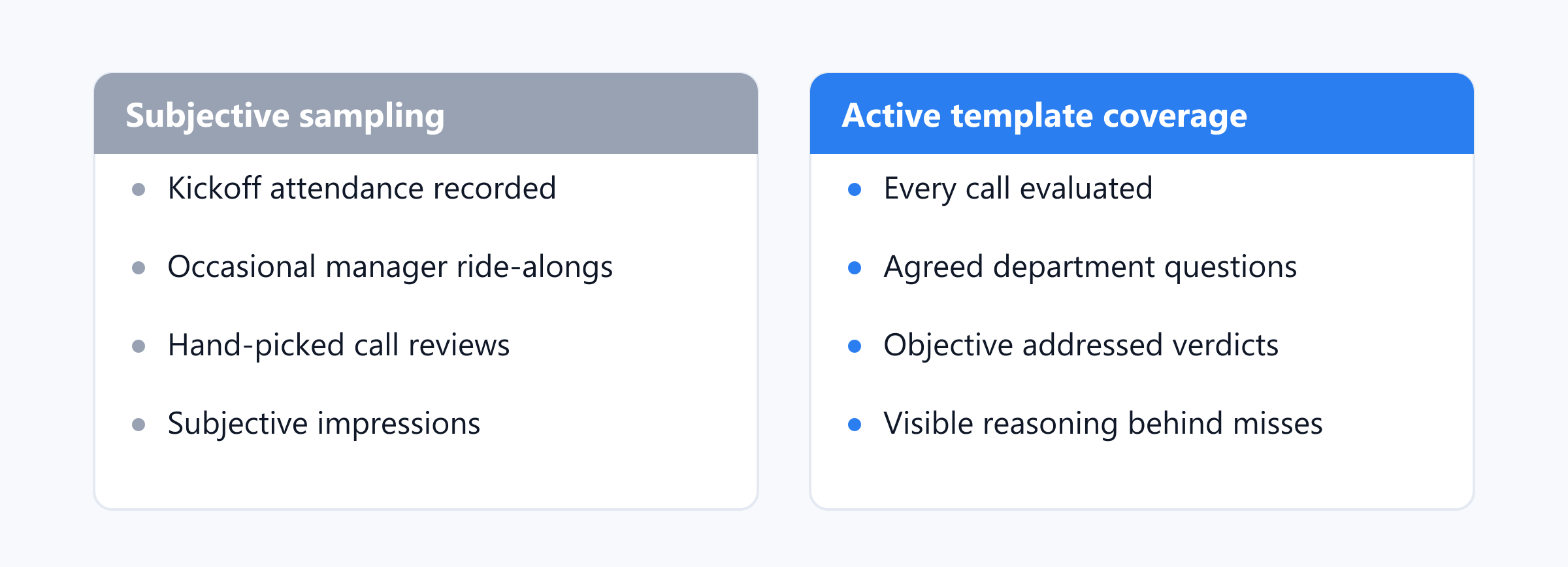
A kickoff explains the methodology. Certification shows that reps can describe it. Manager ride-alongs reveal what happened on selected calls.
None of those tells an enablement leader whether the agreed discovery behavior appears consistently outside the reviewed sample.
The measurement question is specific: did the rep address the required discovery questions or themes? That is different from asking whether the rep sounded polished, whether the opportunity is qualified, or whether the customer received a good outcome.
A discovery methodology is adopted only when the required behavior appears in the calls nobody hand-picked for review.
Keep those management questions separate. Methodology execution measures coverage. Qualification checks whether commercial facts were captured. Call quality evaluates how the rep communicated and listened. Customer outcome shows whether the conversation produced a useful result.
What to measure: coverage, evidence, and execution quality
Question coverage starts with a visible denominator. If an active template contains five required questions and a call addresses four, the call result is four addressed out of five. The scale is clear, and a manager can see which question was missed.
The count alone is insufficient.
Every template question needs an addressed or not-addressed verdict with the model's written reasoning. That evidence lets enablement validate why a question passed, challenge an ambiguous result, and distinguish a missing question from information the prospect volunteered without prompting.
Execution quality belongs in a different measure. A rep might ask about business impact, interrupt the answer, and rush into a pitch. The question could count as addressed while listening quality remains weak.
That is why a discovery call scoring rubric should not collapse everything into one number. Agent Score evaluates technique across six rubric dimensions, including clarity, listening, and commercial execution. Question Coverage evaluates whether the active discovery standard was addressed.
Business checkpoints answer another narrower question. Company-configured checkpoints such as budget, timeline, and decision-maker are evaluated on every analyzed call, with the values captured when found. The call list can then be filtered by whether each checkpoint was captured.
A call can contain budget and timeline while still missing the buyer's operational pain or consequences of delay. How Contexro Verifies Qualification Criteria on Every Sales Call covers that adjacent qualification workflow in more detail.
How Contexro applies your methodology to every analyzed call
Contexro uses a department-specific Question Coverage template to turn the team's discovery standard into a repeatable analysis input. The setup follows a direct sequence.
- Define observable questions. Convert the methodology into questions that can be evaluated from a conversation, such as whether the rep established the current process, business impact, urgency, and decision process.
- Assign the template to a department. Sales teams with different motions can use department-specific templates rather than sharing a generic company-wide checklist.
- Make one template active. Each department has one active question template at a time. Its questions are passed into the analysis of every call in that department.
- Read the call result. After analysis, Contexro records how many active-template questions were addressed out of the total.
- Inspect each verdict. Contexro provides a dedicated Question Coverage view where a reviewer can open the result, see each addressed or not-addressed verdict, and read the model's reasoning.
If a verdict needs validation, the reviewer can open the speaker-labeled, timestamped transcript. Timestamped key moments also jump directly to the relevant point in the recording, avoiding a full-call scrub.
The operating rule matters. Update the active template only when the current discovery standard changes, and treat that edit as a methodology decision rather than casual prompt tuning.
Turn call-level coverage into an enablement rhythm
Review early calls after rollout and look for questions that repeatedly disappear from the conversations you inspect. Start with the behavior, not the rep's assumed motivation.
Open the reasoning before assigning blame. Contexro flags which template questions were missed on each call and whether the prospect supplied the information anyway. A buyer who volunteers a timeline is a different coaching case from a rep who never explores urgency and leaves the subject untouched.
Then compare coverage with execution quality.
Suppose a rep asks what happens if the customer keeps the current process, then interrupts the answer and pivots to features. Question Coverage shows that the topic appeared. Agent Score can surface the listening and commercial execution problem, while per-call coaching insights point back to the transcript evidence.
Contexro surfaces two to three specific coaching tips after a call. Once the gap is clear, How Contexro Turns a Sales Call Coaching Template Into Rep Behavior Change explains the adjacent process for reinforcing that behavior.
Some gaps need ownership rather than another comment in a review meeting. Create a Work Item for the manager to review the next discovery call, assign an owner and due date, and retain a deep link to the originating call moment.
Inspect later calls against the active template to see whether the targeted behavior appears consistently. This supplies evidence of later execution. It does not claim that coaching alone caused the change.
Use the right view for the management question
One score cannot answer every question about sales playbook execution. Use the measure built for the decision in front of you.
| Management question | Use this view | What it shows |
|---|---|---|
| Did the rep address the required discovery questions? | Question Coverage | Addressed questions out of the active-template total, with a verdict and written reasoning for each question. |
| How well did the rep handle the conversation? | Agent Score | Technique across six rubric dimensions, including clarity, listening, objection handling, and commercial execution, with reasoning behind the judgment. |
| Were specific qualification facts captured? | Business checkpoints | Configured facts such as budget, timeline, and decision-maker, including captured values when found. |
| Did the customer or deal receive a good outcome? | Business Score | Customer experience, resolution effectiveness, churn risk, and deal impact, scored independently from rep polish. |
| What is the broader performance context? | Rep trends and manager rankings | Performance patterns across reps and teams, while the call-level Question Coverage drill-down remains the evidence for methodology execution. |
A polished rep can receive a strong technique assessment while leaving the buyer's main implementation concern unresolved. Keeping Business Score independent from Agent Score makes that gap visible.
The same separation explains why a single average can hide the issue. Your sales call scorecard is averaging away the thing you need to see examines that scorecard problem directly.
A practical rollout sequence for a new discovery standard
If the methodology still needs a clear call-stage structure, What Are the 7 Steps of a Sales Call? Make Discovery Measurable covers that design question. Once the standard is settled, use this rollout sequence.
- Translate labels into observable questions. Replace 'understand pain' with a prompt such as, 'Did the rep establish the operational consequence of the current problem?'
- Activate the department standard. Assign the template to the relevant department and make it active before using new calls to assess adoption.
- Calibrate with frontline managers. Review initial verdicts, written reasoning, and transcript evidence together. Tighten ambiguous wording before treating a miss as a rep failure.
- Coach one behavior at a time. If impact questions keep disappearing from the calls under review, focus the next intervention there rather than retraining the entire methodology.
- Inspect subsequent calls. Look for the targeted question in later Question Coverage results and verify the reasoning behind each verdict.
- Keep the layers distinct. Use Question Coverage for methodology execution, checkpoints for qualification, Agent Score for technique, and Business Score for customer and deal outcomes.
Start with one department and a focused set of questions. Review the evidence with the managers who will coach against it, then make the active template the standard used for every analyzed call in that department.
See how Contexro can apply your active discovery template to every analyzed department call, show which questions were addressed, and preserve the reasoning behind each result.