
How Contexro Verifies Qualification Criteria on Every Sales Call
Table of contents
- Why CRM qualification fields do not prove a deal is qualified
- Turn BANT or MEDDIC into checkpoints the AI can verify
- The evidence-backed qualification workflow in Contexro
- What managers should inspect: value, evidence, and the missed-question pattern
- A practical rollout: start with the criteria that change deal decisions
- See qualification evidence on every tracked sales call
A checked CRM field does not prove that qualification happened. To track sales qualification criteria on calls, Contexro detects configured business checkpoints in each processed conversation, captures the spoken values, and flags what the rep missed.
Managers inspect the buyer's words and the timestamped call evidence. Reps get a specific coaching point or follow-up action while the conversation is still current.
Why CRM qualification fields do not prove a deal is qualified
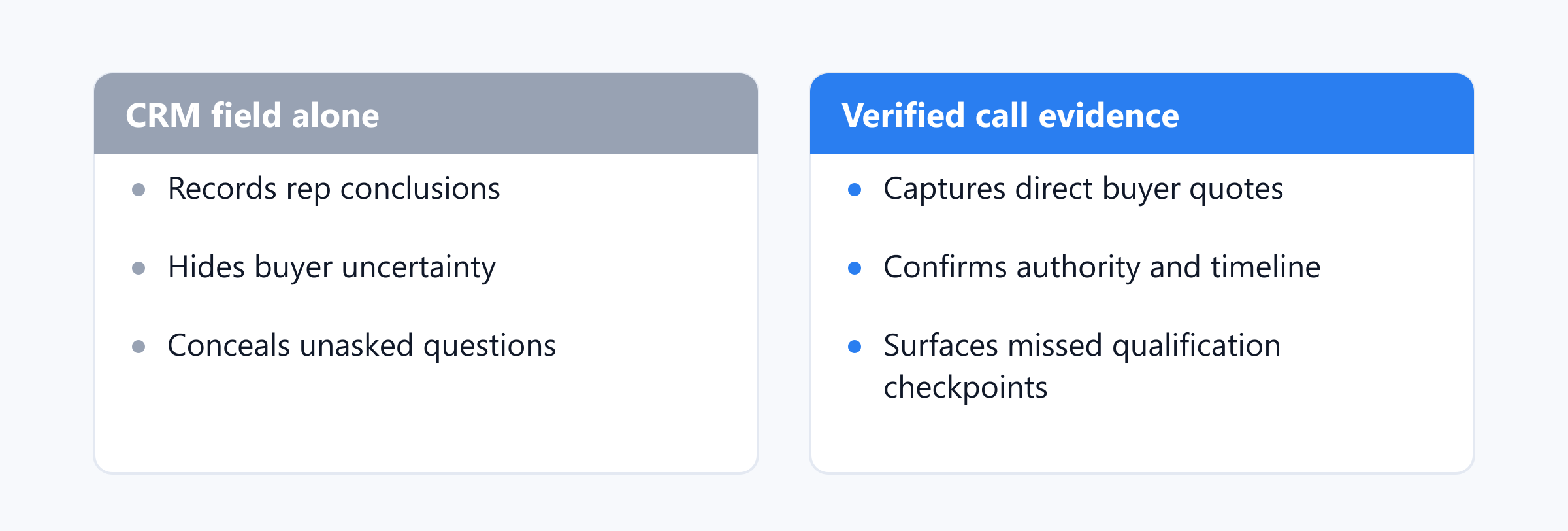
A rep can enter a budget after the call without preserving who supplied the figure, whether it was approved, or whether the buyer sounded certain. The field contains a conclusion. It does not contain the conversation behind it.
A blank field is just as ambiguous. The rep might have skipped the question, or the buyer might have volunteered the information and the rep failed to record it.
| CRM state | What it proves | Evidence standard |
|---|---|---|
| Budget field is populated | A value was entered | The captured value is checked against the buyer's wording in the timestamped transcript or key moment |
| Decision-maker field is blank | No value was saved | The call shows whether the rep missed the checkpoint or the buyer offered the information anyway |
| Timeline says this quarter | A broad date was recorded | The recording shows whether the buyer named a real deadline, event, or dependency |
Manager spot-checking does not fix this. Reviewing a handful of calls cannot establish sales qualification hygiene across every rep, stage, and tracked line.
Contexro captures company-configured checkpoints with values on analyzed calls, then reports exactly which checkpoints were missed and whether the prospect supplied the information without being asked.
A populated field is a rep's conclusion. Qualification hygiene requires the buyer's words and a visible gap when those words do not exist.
Each required criterion should end in one of two places: a captured value supported by call evidence, or a visible reason that the team still considers it unconfirmed. A manager makes that final judgment after reviewing the evidence.
Turn BANT or MEDDIC into checkpoints the AI can verify
Do not configure every discovery question your enablement team has ever written. Start with the criteria that change whether a deal advances, stays open, or needs more discovery.
Contexro provides a cross-call question library and company-configurable business checkpoints. Scoring templates can be aligned to the qualification framework your team already runs.
| Checkpoint | What usable evidence sounds like | What remains incomplete |
|---|---|---|
| Budget | A buyer-stated dollar range, spending limit, or funding constraint | General interest with no indication of available funding |
| Decision-maker | A named person or role with a defined part in approval | A vague reference to leadership or the wider team |
| Timeline | A concrete date, renewal, launch, contract event, or operational deadline | Language such as soon or later this year without a forcing event |
A BANT-based team might configure budget, authority or decision-maker, need, and timeline. A MEDDIC-oriented team might define checkpoints for metrics, the economic buyer, decision criteria, decision process, identified pain, and champion.
These are team-defined checkpoints. Configure only the criteria your managers need to inspect rather than assuming the framework acronym provides the operating standard.
To verify MEDDIC on calls, the team must also define what counts as a usable value. A mention of the CFO does not establish that the CFO is the economic buyer. A reference to an upcoming renewal does not confirm the date or decision process.
If your goal is to automate BANT tracking, keep the term honest. The automation detects and presents checkpoint values and missed items. A person still reviews whether the buyer's statement is explicit enough to accept.
The evidence-backed qualification workflow in Contexro
- Configure the checkpoints. Select the qualification information sellers are expected to establish. Document separately by which point in the sales process each item should be known.
- Bring in tracked calls. Use call sync from Freshcaller, RingCentral, HubSpot and Talkdesk, plus manual and bulk upload. This covers supported tracked lines and uploaded recordings, not every conversation that happens outside those sources.
- Inspect the spoken evidence. Contexro produces speaker-labeled, timestamped transcripts with confidence scores and timestamped key moments linked to the recording. Review the captured checkpoint value, then use the transcript and key moments to hear the relevant exchange without scrubbing the entire call.
- Review missed discovery. Missed-versus-answered reports show exactly which checkpoints were missed on each call. They also show when the prospect offered the information anyway, which separates available deal information from good rep discovery behavior.
- Coach after processing. Reps receive 2-3 specific post-call tips in the dashboard and by email within minutes, subject to rep quiet hours. Managers can compare those tips with the missed checkpoint and transcript evidence instead of sending generic advice after a quarterly review.
- Assign the next action. AI-extracted and manual Work Items support owners, due dates, priorities, comments, and board or list views. If the buyer committed to send procurement dates, that call touchpoint can become a Work Item. If the rep never established the decision-maker, a manager can manually assign that follow-up.
The result is operationally specific. The manager sees what was captured, what was missed, and what the buyer actually said. The rep receives a coaching point or owned follow-up rather than another unread transcript.
How Contexro Turns a Sales Call Coaching Template Into Rep Behavior Change explains the wider coaching loop. In this workflow, the coaching input is a qualification gap backed by the call transcript.
What managers should inspect: value, evidence, and the missed-question pattern
Start at the individual call. Do not accept a captured value until the timestamped evidence supports the team's internal definition.
Use three operating statuses. These are manager review standards, not claims that the AI automatically determines the certainty of every buyer statement.
| Status | What the manager should see | Manager action |
|---|---|---|
| Established | A usable checkpoint value supported by the buyer's words | Accept the evidence and move to the next deal question |
| Discussed but unresolved | The topic appears, but the value is tentative, vague, or dependent on another person | Assign a specific clarification step |
| Missed | The required checkpoint was not established on the call | Coach the discovery behavior and assign buyer follow-up if needed |
Then inspect whether the buyer volunteered the information. A prospect who says, 'Our CFO needs to approve this before the October renewal,' has supplied authority and timeline information. That helps the deal, but it does not prove the rep consistently asks the right questions or listens well enough to capture the answer.
Contexro's missed-versus-answered trends show patterns by rep and week. Rep benchmark comparisons, score distributions, heatmaps, and manager-scoped daily or weekly digests help leaders find recurring gaps without building a judgment from a few memorable calls.
Pair the checkpoint pattern with the call-handling rubric. AI reasoning across communication, listening, objection handling, and commercial execution can help a manager distinguish a listening failure from weak commercial discovery or poor objection handling.
For example, a rep might ask about timing, hear that implementation capacity is the real constraint, and immediately return to pricing. The missing timeline is one problem. The failure to follow the buyer's answer is the coaching diagnosis.
The independent deal-impact metric provides another signal, scored separately from how polished the rep sounded. Treat it as context, not proof that completing qualification checkpoints caused an outcome.
Your sales call scorecard is averaging away the thing you need to see explains why a single blended score can hide these specific patterns.
A practical rollout: start with the criteria that change deal decisions
Begin with budget, timeline, and decision-maker. Missing any of these can leave a manager unable to judge whether a deal has funding, a real deadline, or access to the approval process.
Write one internal definition for each checkpoint. State the acceptable evidence, what counts as incomplete, and the required follow-up when the criterion is absent. Keep those definitions short enough for managers to apply consistently during pipeline inspection.
Review missed patterns weekly by rep and team. Use manager-scoped daily or weekly digests to identify the calls that deserve inspection, then filter the call list by whether each configured checkpoint was captured.
Use post-call tips for rep reinforcement. Use Work Items for buyer-facing follow-up that needs an owner and due date, with statuses such as Open, In Progress, Waiting on Customer, and Completed. Digest emails can surface overdue and due-today work so commitments do not disappear inside transcripts.
Once managers consistently review the evidence and missed-question pattern, add other team-defined criteria carefully. More checkpoints create more inspection work. They do not automatically create better qualification.
For broader call-stage design, use What Are the 7 Steps of a Sales Call? Make Discovery Measurable rather than turning the qualification checkpoint list into a script for the entire conversation.
See qualification evidence on every tracked sales call
Contexro captures configured business checkpoints, shows the values detected on processed calls, and surfaces the missed-versus-volunteered pattern. Your managers can inspect the buyer's wording before trusting a post-call checkbox.
Evaluate the workflow against your own BANT or MEDDIC criteria and supported call sources. Call sync is available from Freshcaller, RingCentral, HubSpot and Talkdesk, plus manual and bulk upload.
The analysis follows the call. It does not provide live prompting, universal call capture, or automatic CRM qualification-field write-back.
See how Contexro can turn your BANT or MEDDIC criteria into evidence-backed checkpoints across every tracked sales call.