
How Contexro Gives Customer Success the Full Sales Story
Table of contents
- The sales to customer success handoff fails before the intro call
- What Customer Success needs before the first onboarding call
- The evidence-first sales handoff process in Contexro
- How a CS leader should review a newly won customer
- What RevOps can standardize without forcing better notes
- A handoff checklist is still useful when it is backed by the calls
A Closed-Won record can contain the commercial basics while leaving Customer Success blind to the concern, expectation, or promise that shaped the deal. Contexro gives CS a searchable chronology across analyzed sales calls, with structured summaries, timestamped evidence, configured checkpoints, objections, competitor context, and owned follow-up work.
The CRM remains useful for required account fields. The sales to customer success handoff becomes more reliable when CS can compare those fields and rep-written notes with what was actually said.
The sales to customer success handoff fails before the intro call
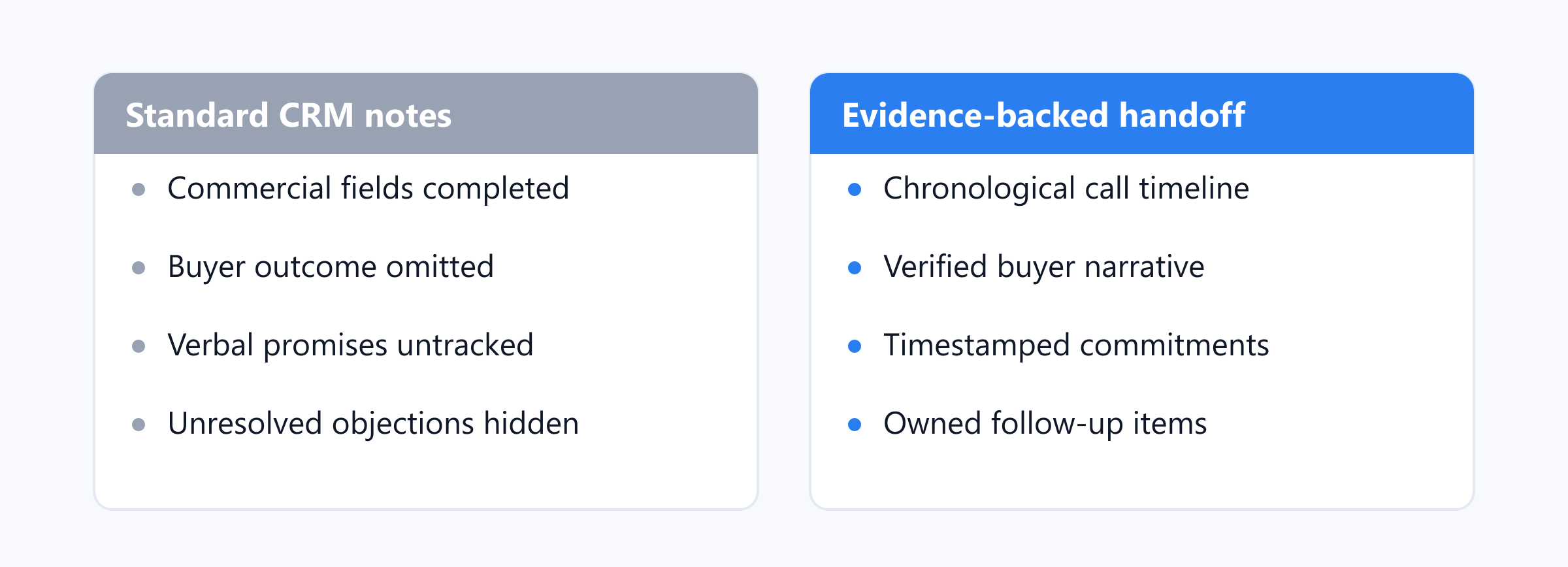
The problem is not always a missing template. It is missing evidence.
A required CRM field might correctly record the budget or planned start date. Free-text notes can still omit why the customer bought, what outcome they expect, which implementation concern remains unresolved, or what Sales agreed to clarify.
Those omissions are hard to spot because no single call necessarily contains the full story. Discovery may contain the original goal. A later evaluation call may contain a feature objection. The closing call may contain the final timeline and an internal commitment.
If CS cannot open the call moment behind a promise, the handoff contains a claim, not evidence.
The result is bigger than repeated questions. CS starts onboarding without a dependable way to prioritize risks, confirm expectations, or identify work that should already have an owner.
What Customer Success needs before the first onboarding call
A useful handoff package should let a CSM reconstruct the buying story and inspect the source behind any high-stakes claim. That customer success onboarding context should cover five areas.
| Check | What good looks like |
|---|---|
| Customer narrative | The stated reason for buying, the intended outcome, and the recorded outcome of the sales conversations are visible in structured summaries. |
| Decision and delivery context | Budget, timeline, decision-maker details, or other company-specific checkpoints appear when the organization has configured them, with captured values and evidence timestamps where available. |
| Expectations and risks | A reviewer can inspect commitments, follow-up context, red flags, positive signals, AI-detected objections, and competitor mentions. Objections are categorized as price, competition, feature, timing, or trust, with handling quality and resolution status. |
| Traceability | Important findings link to timestamped call moments, allowing CS to hear the exchange instead of accepting a summary blindly. |
| Account continuity | The timeline includes every analyzed conversation across the salespeople who spoke with the customer, rather than presenting the latest call as the complete account story. |
AI-detected objections, competitor mentions, sentiment, and risk signals are review leads. They are not infallible facts. CS should inspect the surrounding call context before changing an onboarding plan or raising an issue with the customer.
The evidence-first sales handoff process in Contexro
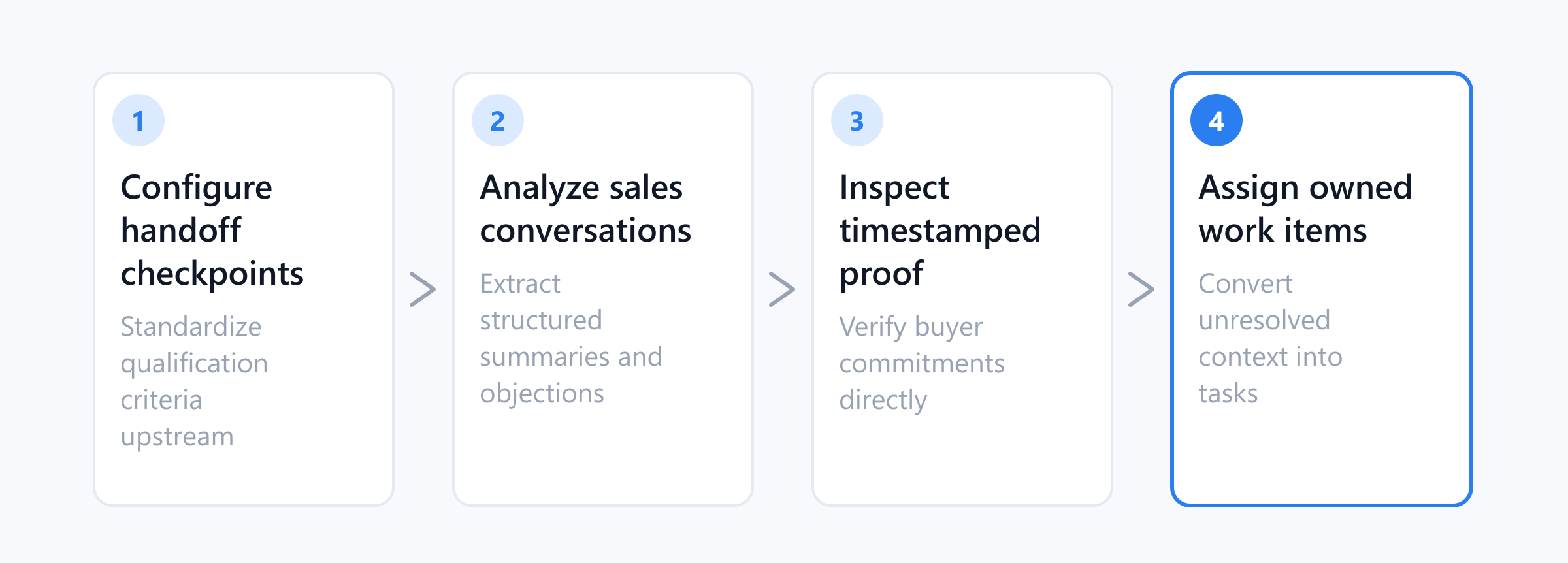
This workflow does not require Sales to rewrite every call into perfect prose. It preserves the conversation record, organizes the parts that matter, and gives a person the evidence needed to decide what happens next.
- Define the handoff context. RevOps configures up to 25 department-specific checkpoints using the organization's own descriptions. Question coverage templates can reflect the discovery and qualification process the team already runs. Budget, timeline, and decision-maker details should only be treated as required when those checkpoints have been configured.
- Analyze the relevant conversations. Confirm which sources are active in the deployment. Contexro accepts call sync from Freshcaller, RingCentral, HubSpot, and Talkdesk, plus manual and bulk upload. After a call is processed, the report includes an AI-generated TL;DR and structured purpose, outcome, and narrative summary, along with topics, configured checkpoints, objections, competitor mentions, sentiment, and detected signals.
- Preserve the proof. Timestamped key moments jump directly to the relevant point in the recording. A CSM can inspect the exchange behind an expectation or concern without scrubbing through the full call. Captured checkpoint values also include evidence timestamps where available.
- Review the customer, not one call. Contexro builds a searchable Customer 360 profile with a chronological timeline across every rep who spoke with the customer. It brings together call history, summaries, objections, linked follow-up context, red flags, and Business Score categories.
- Turn unresolved context into owned work. A user can create Work Items from AI analysis, a transcript line, a key moment, a call header, an analysis section, or manually. Each item can carry an owner, due date, priority, tags, comments, status, and a deep link to the originating call moment. AI-extracted items can pass through a human review queue before the team trusts the task list.
- Prepare the first CS conversation. The CSM uses the timeline to build an evidence-checked agenda. Confirm the intended outcome, address unresolved concerns, and establish who owns each next step instead of asking the customer to reconstruct the sales cycle.
For teams redesigning discovery upstream, What Are the 7 Steps of a Sales Call? Make Discovery Measurable explains how question coverage can make required context observable before the deal reaches CS.
Evaluate the actual handoff. See how Contexro puts the customer timeline, timestamped evidence, objections, configured checkpoints, and follow-up Work Items into one review before onboarding.
How a CS leader should review a newly won customer
After Sales marks a deal Closed-Won in its system, make the evidence review a recommended CS operating step. This is a team procedure, not an automatic deal-stage trigger inside the platform.
- Start with the timeline. Open the Customer 360 profile and scan the sequence across sales participants. Look for the progression from discovery through evaluation, commitment, and close. This establishes where each part of the account story came from.
- Compare both records. Read the latest purpose, outcome, and narrative summaries, then compare them with the available CRM handoff material. Treat neither source as complete by itself. A structured CRM field may be more current, while a recorded exchange may explain why the value matters.
- Inspect objections and competitors. Review objection type, handling quality, resolution status, and surrounding transcript evidence. Open competitor mentions to understand the context and sentiment. A detected mention does not automatically mean the competitor drove the decision.
- Play the high-stakes moments. Listen to the source behind an implementation expectation, unresolved concern, or follow-up commitment before placing it on the kickoff agenda. This is where an ambiguous summary becomes a verified issue or gets ruled out.
- Assign the gaps. Create Work Items for clarification from Sales, an internal dependency, or a customer-facing follow-up. Give each item an owner and due date, then use a status such as Open, Waiting on Internal, Waiting on Customer, or Completed to keep the handoff visible.
This sequence prevents a common failure in the sales handoff process: copying uncertain context into a new document and calling it complete.
What RevOps can standardize without forcing better notes
RevOps can govern what the organization expects to learn without prescribing how every rep writes a handoff paragraph. Configure the relevant department profile, question coverage template, scoring rubric, and checkpoints before using the resulting reports to judge process quality.
A missing captured checkpoint is a review cue. It does not prove the rep failed to ask.
Contexro can flag which configured questions were missed on a call and whether the prospect offered the information anyway. RevOps can then open the transcript evidence and distinguish an unasked question, an unanswered question, and information that surfaced without the expected prompt.
Call filters show where a configured value was or was not captured. Customer filters and account timelines help RevOps prioritize transition reviews instead of opening every call in chronological order.
Keep execution and outcome separate. Agent Score evaluates call-handling technique across six rubric dimensions, including clarity, listening, and commercial execution. Business Score is assigned independently as an outcome-oriented measure on analyzed calls.
A rep can explain pricing clearly and handle the objection well while the customer still ends the call concerned about implementation. The two scores expose that difference, but neither replaces the account review. Business Score should not be treated as a direct measure of retention, NRR, churn, or overall customer health.
Your sales call scorecard is averaging away the thing you need to see explains why technique and customer outcome should not disappear into one blended number. For gaps rooted in rep execution, How Contexro Turns a Sales Call Coaching Template Into Rep Behavior Change shows how transcript-backed coaching moves from a template to per-call feedback.
Patterns across handoffs can also change the process itself. Repeated timing objections may justify an earlier implementation discussion. Frequent competitor appearances may change enablement material. Missing delivery context may require a new checkpoint or a stronger question coverage standard.
Detection starts the review. A person still decides whether to change Sales enablement, discovery requirements, or the CS onboarding plan.
A handoff checklist is still useful when it is backed by the calls
A checklist establishes ownership, and a CRM workflow can route the record. By themselves, they do not verify whether the customer context was captured accurately.
Before the first onboarding call, the team should be able to meet three tests:
- See the account story. The sequence of discovery, evaluation, concerns, commitments, and close is visible across the analyzed conversations.
- Inspect the evidence. High-stakes claims can be checked against timestamped call moments and surrounding context.
- Own the remaining gaps. Clarifications and follow-ups have named owners, due dates, and links back to their source.
Contexro supports that standard with customer timelines, AI-generated summaries, timestamped key moments, configurable checkpoints, objection and competitor analysis, and assignable Work Items.
See the account context behind the handoff, not just the notes. Review how Customer Success can inspect the sales story and assign unresolved work before onboarding.