
How Contexro Explains the Gap Between Dials and Analyzed Calls
Table of contents
- The mismatch is usually a counting problem before it is an AI problem
- Build a Dial-to-Analysis Ledger that every record can pass through
- Classify non-analyzed calls without producing an excuse sheet
- Run the monthly reconciliation audit before the executive review
- Use Contexro to make skipped-call coverage visible in the operating cadence
- Turn the reconciliation into a controlled operating metric
- Continue from coverage into call performance
The gap between dials and analyzed calls becomes defensible when every source dial follows one path through a reconciliation ledger. Define what each system counts, match source events to traceable records, separate analysis candidates from exclusions, and assign every record one status at the reporting cutoff.
Executives then see a controlled coverage metric, not a vague AI miss rate.
The mismatch is usually a counting problem before it is an AI problem
A dialer may count an attempt, connected call, call leg, retry, transfer, or disposition event. A conversation intelligence platform usually reports recordings or call records that reached its analysis flow.
Those units are not interchangeable.
To reconcile dial volume call analytics correctly, start by confirming what the dialer or CRM metric means in your environment. Do not rely on a generic vendor definition when local routing, retry, and transfer settings can change the count.
| Counting contract check | What a passing answer contains |
|---|---|
| System of record | The named dialer or CRM report that owns the raw activity total for this reconciliation. |
| Reporting window | Start date, end date, time zone, and treatment of events crossing the period boundary. |
| Count grain | A confirmed statement that the metric counts attempts, connected calls, call legs, recordings, dispositions, or another defined unit. |
| Call direction | Whether inbound, outbound, or both directions are included. |
| Coverage scope | The employees, departments, tracked lines, and source accounts included during the period. |
| Retries and transfers | A documented rule for whether each retry, transfer, or separate call leg creates another source event. |
This contract changes the executive framing. Raw dial volume measures activity under the source system's rules. Analyzed-call volume measures coverage and processing under the analysis platform's rules.
A coverage percentage is defensible only when every source event either reaches analysis or lands in one named, mutually exclusive ledger status.
Build a Dial-to-Analysis Ledger that every record can pass through
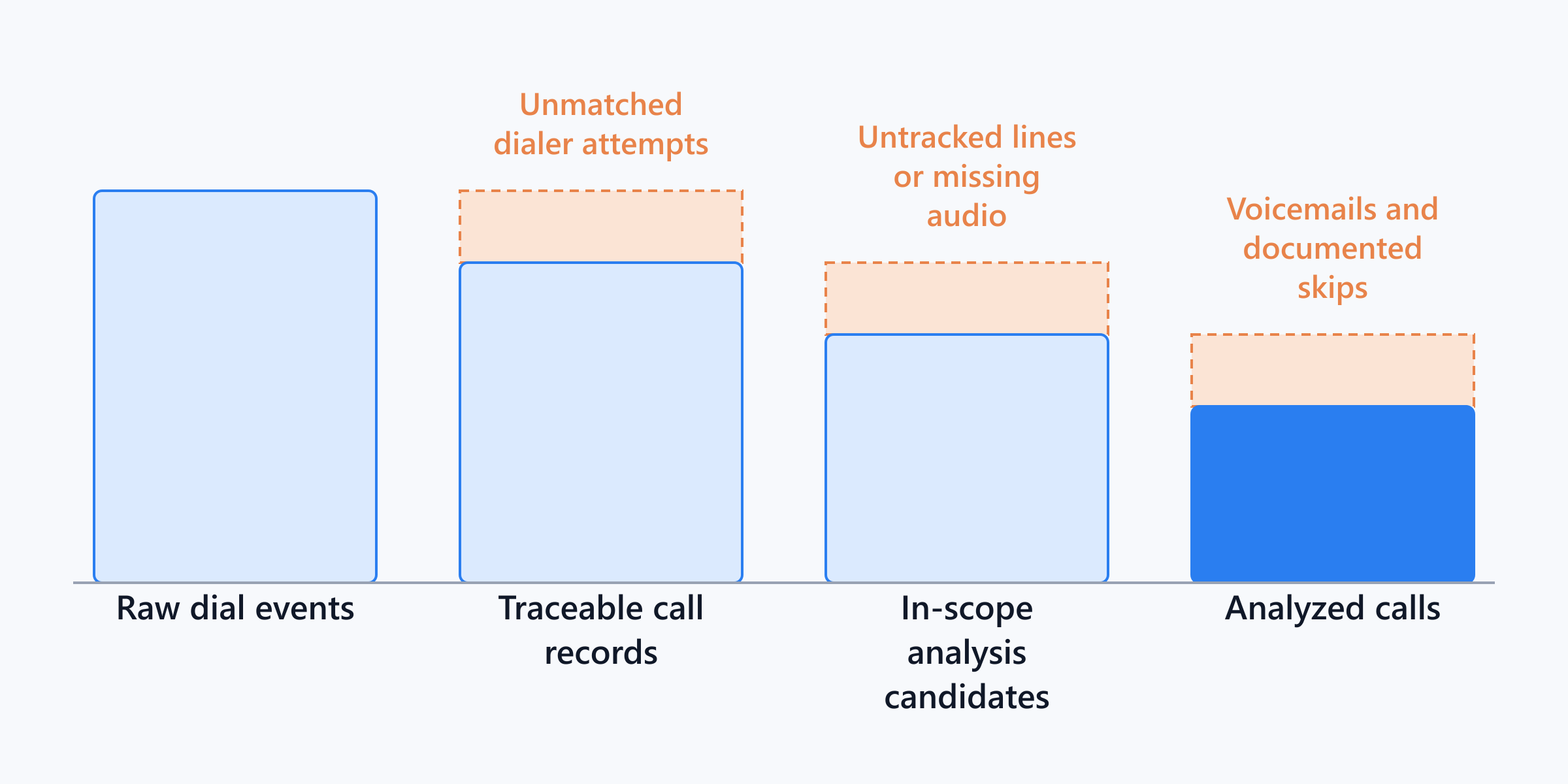
Dashboard totals cannot explain the gap by themselves. RevOps needs a four-stage ledger that preserves the source population while showing where each record moved or stopped.
| Ledger stage | What enters | Required output |
|---|---|---|
| 1. Source dial events | The raw activity export from the agreed dialer or CRM for the frozen reporting period. | Every source row, with the available identifier, timestamp, direction, employee or line, and disposition where present. |
| 2. Traceable call records | Source events matched to a call or recording record through verified identifiers and documented fallback rules. | Traceable records plus a separate unresolved population. Together, they must equal the source-event total. |
| 3. Analysis candidates | Traceable records within the intended employee and line scope that have the content required for analysis. | In-scope candidates, out-of-scope records, and records without usable content. These branches must equal the traceable population. |
| 4. Analysis status at cutoff | Every in-scope candidate that reached the AI call analysis pipeline. | Analyzed, skipped by recorded reason, pending or under review, or excluded under a published rule. The statuses must total the candidate population. |
The arithmetic is basic by design. At every stage, the records that continue plus the records diverted into named categories must equal the incoming population.
A record can change status later. At the reporting cutoff, it occupies one category only.
Show this as a waterfall or ledger. A single percentage labeled call analytics coverage hides whether the denominator contains retries, untracked lines, missing recordings, or open processing work.
If you publish rates, name both denominators. Traceability compares matched call records with source events. Analysis coverage compares analyzed calls with in-scope analysis candidates. Analyzed calls divided by raw dials is a blended conversion measure, not a clean processing rate.
Classify non-analyzed calls without producing an excuse sheet
Every non-analyzed category should tell an operator what happened and who owns the next step. Generic labels such as missing or not analyzed do neither.
| Ledger category | Reporting treatment | Likely owner |
|---|---|---|
| Out of scope | Report calls from deliberately untracked lines or disabled employees as coverage choices, not processing failures. | RevOps or the conversation intelligence administrator |
| Voicemail or no useful conversation | Keep detected voicemail separate from unexplained gaps. Do not count the same record again under a generic processing category. | RevOps reporting |
| Content unavailable | Investigate records that lack a usable recording or the source data required to enter analysis. | Telephony or integration owner |
| Skipped by recorded reason | Use the actual processing reason and its documented definition. Do not collapse distinct reasons into one exception count. | Conversation intelligence administrator or integration owner |
| Pending or under review | Keep open work separate from permanent failures, especially in near-real-time reporting. | Conversation intelligence administrator |
| Unresolved source event | Preserve source events that cannot yet be matched. Never remove them to improve the coverage percentage. | RevOps and the integration owner |
Publish status precedence as part of the contract. If voicemail is a terminal business outcome in your ledger, that record cannot also appear under processing failure in the executive rollup.
Long recordings need a separate test. Confirm that the platform completes them through chunked processing rather than allowing length alone to remove them from the analyzed population. Investigate an absent long call as a specific record, not as an assumed platform limitation.
Skipped call reporting should expose the recorded reasons available in the current configuration. Exact labels can vary, so RevOps should validate the taxonomy before translating it into executive categories.
Run the monthly reconciliation audit before the executive review
The ledger only becomes an operating metric when the same sequence runs every month.
- Freeze the reporting contract. Record the window, time zone, source system, call directions, tracked scope, and count grain before pulling totals.
- Capture the source population. Export the raw dial events from the agreed system of record and preserve that file as the starting population.
- Match the records. Pull the call and analysis-status population for the same period. Use verified identifiers first, then documented fallback rules based on the fields the connected systems actually provide.
- Segment before diagnosing. Break the gap down by line and employee. A concentration on one line or one employee points toward configuration or routing faster than an account-wide percentage.
- Review the exceptions. Inspect skipped reasons, voicemail cases, pending records, missing content, and long-call cases before assigning a root cause.
- Publish one executive table. Show the source population, in-scope candidates, analyzed calls, named exceptions, open records, and unresolved source events together.
- Assign follow-up ownership. Give each unresolved category an owner and due date. Set an internal variance threshold that triggers investigation rather than borrowing an unsupported industry benchmark.
| Executive row | What it means |
|---|---|
| Source dials | The complete activity population under the agreed dialer or CRM counting rule. |
| Traceable call records | Source events successfully matched to a call or recording record. |
| In-scope analysis candidates | Traceable records within the tracked employee and line scope that have usable content. |
| Analyzed calls | Candidates that completed analysis by the reporting cutoff. |
| Skipped by reason | Candidates that did not complete analysis, grouped by mutually exclusive recorded reasons. |
| Pending or under review | Open records reported separately from completed and failed outcomes. |
| Out of scope | Traceable calls deliberately excluded by the counting contract. |
| Unresolved records | Source events that still lack a defensible match or final classification. |
For an illustrative monthly source population of 5,000 dial events, use this executive structure: "Of 5,000 source dials, X were in scope and traceable for analysis. Y were analyzed. The remaining in-scope records are accounted for by these named statuses, with Z requiring remediation." Replace X, Y, and Z with ledger totals.
Do not claim full coverage while unresolved records remain hidden. Show them, assign them, and close them through the next audit cycle.
Use Contexro to make skipped-call coverage visible in the operating cadence
Contexro provides call volume and activity context alongside a skipped-call breakdown by reason in digests and operational views. Visibility by employee and by line helps RevOps locate whether a gap is concentrated in setup, routing, or tracking scope.
Contexro's AI Processing Pipeline classifies skipped calls by reason during processing. Map the reasons shown in the customer's configuration into the ledger taxonomy rather than assuming every account uses identical labels.
Contexro's voicemail-aware detection separates voicemail from unexplained analysis gaps. Long calls are handled through chunked processing, so length alone does not remove them from the analyzed population.
Use Contexro's call and customer filters to triage records already in the platform. When a coverage issue needs remediation, create a Work Item with an owner and due date instead of leaving the issue inside a dashboard observation.
Do not use Contexro as a substitute for the dialer or CRM's raw dial total unless the source mapping has been verified for that integration and reporting period. The Dial-to-Analysis Ledger still begins with the agreed source export.
Turn the reconciliation into a controlled operating metric
RevOps should leave the audit with three artifacts: a signed counting contract, a ledger that ties every source event to one reporting status, and owned follow-up work for every unresolved category.
Want a coverage report your executives can trust? See how Contexro surfaces skipped-call reasons, voicemail outcomes, line- and employee-level visibility, and the calls that need follow-up.
Continue from coverage into call performance
Once the analyzed population is defensible, read Your sales call scorecard is averaging away the thing you need to see before drawing conclusions from blended performance averages.
For source-specific pipeline context, see How Contexro Turns RingCentral Calls Into Revenue Operations Signals.
For the platform selection stage, Gong vs. Contexro: Choose Conversation Intelligence That Drives Action explains the separate question of what happens after calls are captured and analyzed.
Managers moving from coverage into coaching can use How Contexro Turns a Sales Call Coaching Template Into Rep Behavior Change.
Teams defining measurable discovery stages should also read What Are the 7 Steps of a Sales Call? Make Discovery Measurable.