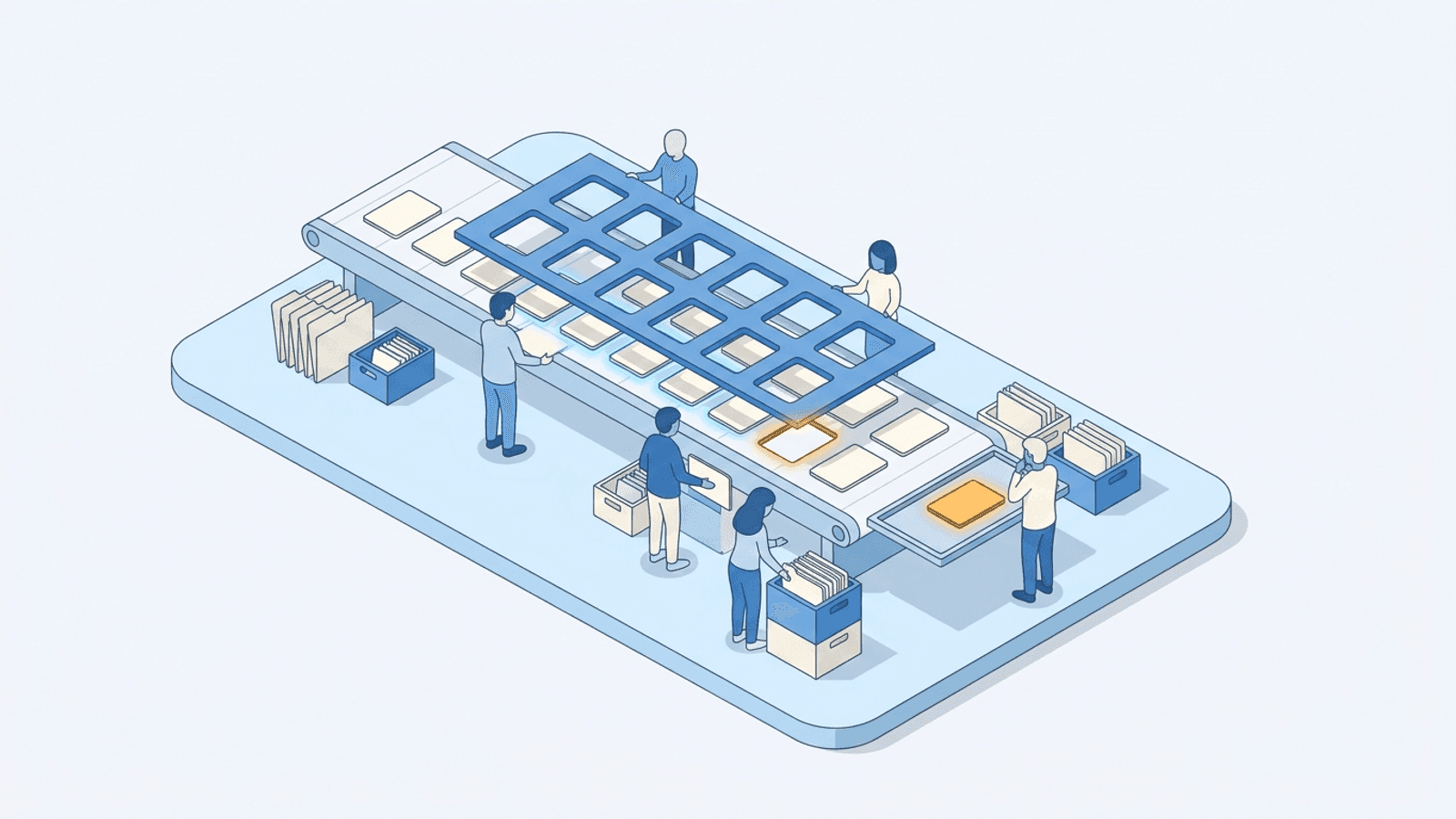
How Contexro Turns RingCentral Calls Into Revenue Operations Signals
Table of contents
- RingCentral recordings are useful only when they enter an operating loop
- 1. Sync the calls that matter, then make exceptions visible
- 2. Score the customer outcome separately from the rep's technique
- 3. Turn recurring conversation signals into revenue and service intelligence
- 4. Convert analysis into owned follow-up, not another dashboard
- 5. Give each role the same source of truth at the right altitude
- What to validate before choosing AI analysis for RingCentral
- Run one controlled RingCentral pilot
RingCentral can remain the calling system while Contexro automatically syncs recordings made available to the integration and analyzes them after processing. The result is a governed loop that separates customer outcomes from rep technique, finds recurring revenue signals, and assigns validated follow-up.
If you need to analyze RingCentral calls, do not judge the deployment by transcript quality alone. To evaluate Contexro, ask to see one permissioned recording move from sync through separate scores and into an assigned Work Item.
RingCentral recordings are useful only when they enter an operating loop
A transcript explains what happened on one call. RevOps needs more: comparable scoring, recurring-pattern detection, ownership, and views that managers can use without sampling calls at random.
RingCentral supplies the calling infrastructure and recordings. Contexro adds post-call Conversation Intelligence through an automatic sync and recording pipeline. It is an analysis layer, not a replacement phone system.
That architecture does not prove every RingCentral environment connects without configuration changes. IT still needs to validate the recording source, permissions, supported call types, and any setup required for the intended deployment.
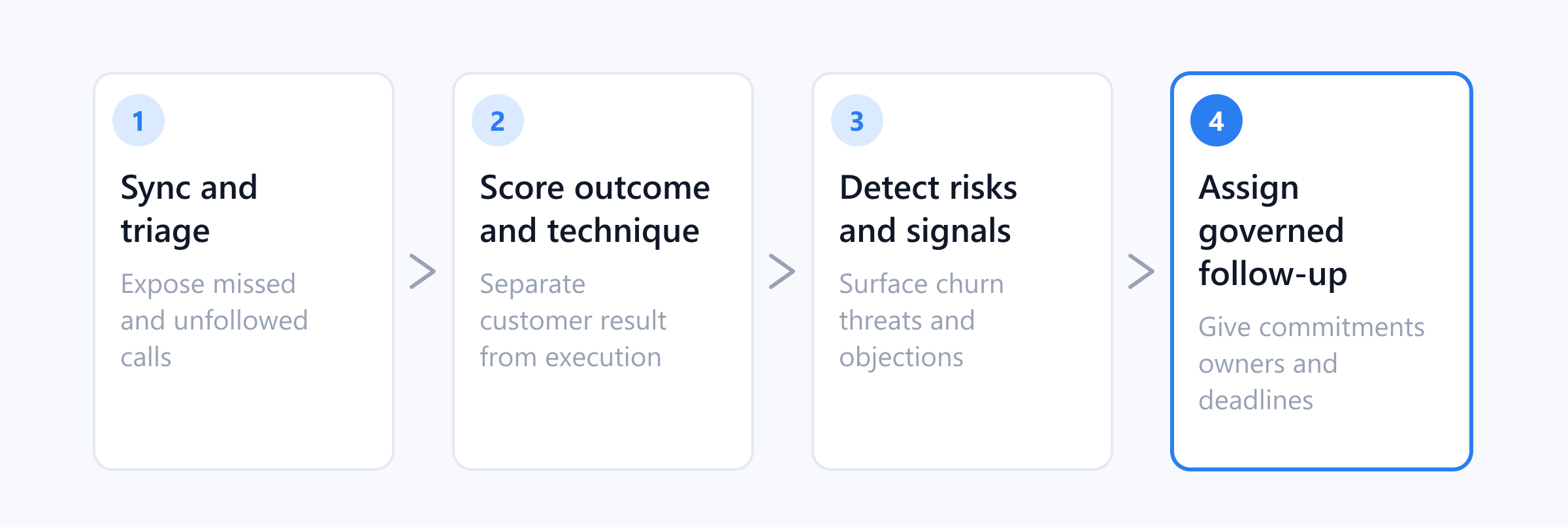
The operating sequence has four layers:
- Sync and triage. Bring in recordings from the tracked employees or lines, then expose missed, voicemail, skipped, and unfollowed cases.
- Evaluate outcome and technique. Score what happened to the customer separately from how the rep handled the conversation.
- Detect risks and signals. Find objections, competitors, missing business checkpoints, red flags, resolution signals, and churn risk across calls.
- Assign and govern action. Validate extracted commitments, give them owners and due dates, then surface overdue work to the right manager.
Before analysis starts, confirm which recordings the integration can access, which employees or lines belong in scope, and whether recording consent, retention, and access policies permit that analysis.
If a finding cannot be traced to the call and assigned to a person, it is reporting, not an operating loop.
1. Sync the calls that matter, then make exceptions visible
Contexro uses a RingCentral automatic sync and recording pipeline to bring configured call recordings into the AI Processing Pipeline. Coverage can be set per employee or per line, so RevOps does not have to treat every call as equally relevant.
An administrator can turn per-employee tracking on or off and swap tracked lines from the admin console. That makes scope a deliberate operating decision rather than an accidental result of which recordings happen to appear.
Document the scope before launch. IT should confirm the supported recording source and integration prerequisites. RevOps should name the teams and lines being measured. Legal or compliance owners should approve the applicable consent, access, and retention rules.
Exceptions matter as much as analyzed conversations.
Skipped-call breakdowns make excluded activity visible by reason. Operational views can surface missed and voicemail cases, while unfollowed inbound voicemails with no later connected follow-up can be filtered so a manager assigns the callback and enforces it.
This is visibility and accountability. It does not place the outbound call automatically, and it should never be described as catching every missed call.
Call filters let managers triage by outcome, red flags, and unfollowed status. Customer filters add contact frequency, showing where effort is concentrated without attempting to prevent or throttle contact.
Verify the precise skipped-call categories available in the planned deployment. A label used in a product demonstration is not a substitute for testing the RingCentral call types your teams actually produce.
This workflow follows the call. It does not provide live prompts or real-time agent assistance. A structured report becomes available after the recording has been processed.
2. Score the customer outcome separately from the rep's technique
A buyer says the price is acceptable but raises a serious implementation concern. The rep speaks clearly, listens without interrupting, and handles the commercial discussion well, yet ends the call without resolving the implementation risk or agreeing on a next step.
One blended quality score can hide that failure.
Business Score measures the customer or business outcome independently. Its criteria can cover customer experience, resolution effectiveness, churn risk, and deal impact, so a polished conversation does not conceal an unresolved buyer.
Agent Score evaluates call-handling technique across six rubric dimensions, including clarity, listening, objection handling, and commercial execution. Contexro attaches AI reasoning and transcript evidence to those judgments rather than leaving managers with an unexplained score.
The distinction works in the other direction too. A customer may reject the proposed timeline because of an internal legal review, leaving the business outcome weak even though the rep handled the conversation correctly. A poor outcome is not automatically poor rep execution.
One company-wide Business Score definition sets what a good outcome means. Saved instructions apply to calls analyzed from that point on and to calls that are reprocessed. Historical calls are not silently recalculated.
Agent Score profiles remain separate by department. Department scoring & coaching can use different profiles and question-coverage templates for Sales, Support, and Customer Success rather than judging every team against one generic rubric.
Question coverage also shows which expected questions were missed and whether the prospect supplied the information anyway. Scoring templates can align to the qualification framework the team already runs without pretending to be a packaged MEDDIC, SPIN, or Challenger product.
Managers can open timestamped key moments and per-call coaching insights to inspect the evidence. That review step matters before either score becomes part of a performance decision.
Your sales call scorecard is averaging away the thing you need to see explains why one composite number can hide an unresolved customer. How Contexro Turns a Sales Call Coaching Template Into Rep Behavior Change shows how evidence-backed coaching becomes a repeatable management cadence.
3. Turn recurring conversation signals into revenue and service intelligence
Scoring is only useful when a manager can see what created it.
Each analyzed call can include an AI-generated TL;DR, a structured purpose, outcome, and narrative summary, and a speaker-labeled timestamped transcript with confidence scores. Timestamped key moments jump directly to the relevant point in the recording.
Sentiment and conversation-phase awareness add context. Talk ratio, silence, and the longest monologue show whether the rep dominated discovery, while phase-aware review helps distinguish a long product explanation from a long opening monologue.
Configured business checkpoints turn recurring discovery requirements into filterable data. An administrator can define up to 25 checkpoints in Settings using the organization's own semantic descriptions, such as budget, timeline, and decision-maker.
The system captures the stated value and an evidence timestamp where available. The calls list can then be filtered by whether each value was captured, which is different from searching generic topic keywords.
What Are the 7 Steps of a Sales Call? Make Discovery Measurable covers how those checkpoints can follow a defined sales process without reducing discovery to script compliance.
Objections need the same structure. Suppose a buyer says a named competitor includes onboarding at the same price. That conversation contains both a competition objection and a price objection, but the operational question is whether the rep addressed either concern well.
Contexro categorizes typed objections such as price, competition, feature, timing, and trust. It then records whether the objection was addressed well, handled poorly, or ignored, so leaders can separate objection volume from objection-handling quality.
How Contexro Helps Teams Build Objection Handling Scripts That Reps Use explains how those observed gaps can feed coaching rather than another static enablement document.
Competitor detection is alias-aware. It records the context and sentiment around a mention, then aggregates appearances by period and department. The Objection intelligence view and Competitor intelligence dashboard expose handling trends, objection spikes, and new competitor appearances.
Red flags, positive signals, issue-resolution signals, and churn-risk signals narrow the review queue further. Managers can start with calls carrying evidence of risk instead of listening to whichever recording happens to be selected.
Customer 360 adds the account context. It combines call history, Business Score categories, red flags, objections, summaries, and a chronological timeline across every rep who spoke with that customer.
4. Convert analysis into owned follow-up, not another dashboard
A buyer asks for a revised order form by Friday, and the rep agrees. That commitment should not die in the transcript.
Contexro can turn the extracted commitment into a Work Item with an owner and due date. AI-generated action items feed the dedicated Work Items layer, but users can also create items from a transcript line, key moment, call header, analysis section, or manual entry.
Each item can carry an assignee, due date, priority, tags, comments, mentions, attachments, and history. A deep link takes the assignee back to the originating call moment, so the work retains its evidence and context.
Work Item statuses include Open, In Progress, Pending Review, Waiting on Customer, Waiting on Internal, On Hold, Completed, and Cancelled. These describe task state. They are not CRM pipeline stages.
The AI Review queue is the control point. A person validates extracted work before the organization treats the queue as a source of operational commitments.
Detection is not prevention. Visibility is not automatic escalation.
RevOps still needs ownership rules for deal follow-up, service recovery, and coaching. Managers need to decide what happens when an item becomes overdue, who can reassign it, and when a customer-facing commitment requires another review.
Board, list, and My Items views support daily work. Overdue and due-today items also appear on dashboards and in executive digests, giving managers a direct route from a missed commitment to the call evidence.
Gong vs. Contexro: Choose Conversation Intelligence That Drives Action examines the same operating choice: whether analysis remains a review artifact or becomes owned work.
5. Give each role the same source of truth at the right altitude
One operating loop does not mean one dashboard for everyone. The evidence should stay consistent while access, detail, and management cadence change by role.
- Executives see business exposure. Their view can lead with the Business Score average and period-over-period delta, followed by at-risk and red-flag counts, score distribution, top trends, objection and competitor rollups, and overdue Work Items.
- Managers see team behavior. Team KPI views, rep trends, ranking views, score drops, low-score clusters, and coaching evidence link into filtered call queues. Goals include progress tracking that a manager reviews.
- Reps see specific coaching. After every analyzed call, reps receive two or three coaching tips in the dashboard and by email, with transcript evidence behind the advice and quiet-hour settings respected.
- Operations sees recurring patterns. Manager-scoped daily and weekly digests can surface department trends, objection spikes, competitor appearances, red flags, and overdue work within each manager's reporting tree.
- IT controls scope and credentials. Role-scoped company and team views follow the reporting hierarchy across direct and indirect reports. API-enforced scoping applies across dashboards, calls, customers, tasks, and digests, while custom roles control menu permissions beyond the default roles.
Integration owners can create, rotate, and deactivate credentials from Integrations without redeploying. The integration card shows last access, and allowed origins can be configured where applicable.
Validate the reporting hierarchy, role design, digest recipients, and KPIs permitted in email before launch. Confirm that the required controls and delivery options are available for the selected plan and deployment.
What to validate before choosing AI analysis for RingCentral
A vendor demonstration should follow your recording through the full operating sequence. Use this checklist to keep the evaluation tied to deployment reality.
| Check | What good looks like |
|---|---|
| Recording ingestion and coverage | A documented inventory shows which RingCentral recordings can be synced, which employees or lines will be tracked, and which recording, consent, retention, and access policies apply. |
| Outcome versus execution | The platform scores the customer or business result separately from rep technique, with stakeholders agreeing on what each score means before using it in performance reviews. |
| Configuration | Your team can define business checkpoints, objection categories, competitor aliases, a company-wide outcome definition, and department-specific Agent Score profiles without accepting a generic taxonomy. |
| Evidence | Material findings link back to speaker-labeled transcript evidence and a timestamped recording moment that a manager can inspect. |
| Exceptions | Missed, voicemail, skipped, and unfollowed cases remain visible by supported reason instead of disappearing from operational reporting. |
| Owned follow-up | Validated findings can become Work Items with owners, due dates, priorities, review controls, history, and role-appropriate visibility. |
| Access governance | IT can govern credentials, rotation, deactivation, reporting hierarchy, roles, team scope, and allowed origins where applicable. |
| Pilot success | The pilot measures recording coverage, finding quality, follow-up completion, and management usage rather than counting transcripts. |
Assign cross-functional owners before the pilot starts. RevOps should own scoring design and follow-up rules, IT should own integration access and credentials, and department leaders should own manager adoption.
See how Contexro analyzes your RingCentral calls and turns the findings into scored outcomes, coaching evidence, and owned follow-up work.
Book a RingCentral walkthrough
Run one controlled RingCentral pilot
Start with one department and one tracked employee or line. Use permissioned calls containing real price, timing, feature, trust, and competitor discussions, then test whether each finding leads back to evidence.
Define the Business Score before managers see it. Configure the department's Agent Score profile, checkpoints, objection types, and competitor aliases. Review AI-extracted Work Items through the AI Review queue until the team trusts the process.
Judge the pilot on four things: whether the intended recordings arrived, whether findings matched the evidence, whether assigned work was completed, and whether managers used the views in their normal cadence.
Start free: 1 track line, 199 minutes, 1 month. No credit card required.