How Contexro Finds the Calls Your Home Services Team Missed
Table of contents
- The Dispatch Leak Is Bigger Than the Calls You Can See
- Calculate What a Missed Call Is Worth to Your Business
- A hypothetical example
- Audit the Calls Between the Phone System and the Schedule
- Build a Recovery Workflow With an Owner, Due Date, and Disposition
- Use Missed-Call Patterns to Coach the Calls That Were Answered
- How Contexro Supports the Dispatch Leak Loop
- Run the First Dispatch Leak Audit
Your schedule only shows the jobs your team caught. To find the leakage, treat every missed, voicemail, and unfollowed inbound call as an exception that needs a value, an owner, a deadline, and a final disposition.
The operating method is the Dispatch Leak Loop: measure the exposure, surface the silent drop-offs, then close them with recovery work and targeted coaching.
The Dispatch Leak Is Bigger Than the Calls You Can See
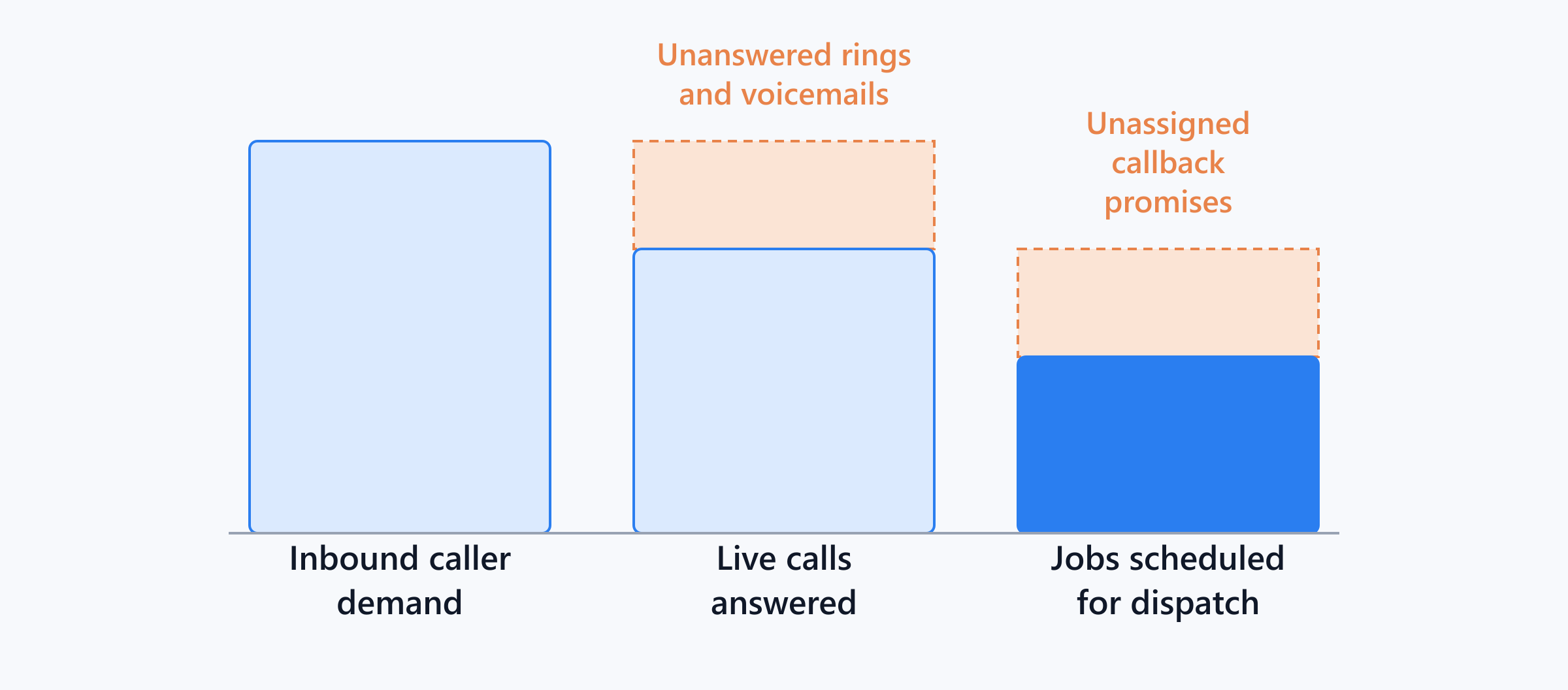
A full schedule does not prove every viable caller received a next step. It only shows who made it through the phone workflow and into dispatch.
Other callers reached voicemail. Some hung up without leaving a message. Others spoke with an office employee who promised a callback, but nobody owned that promise and nothing was scheduled.
A ringing phone is an event. A viable caller with no documented next step is revenue exposure.
Set internal definitions before counting anything. Phone systems label calls differently, so operations needs one shared taxonomy.
| Status | Internal definition |
|---|---|
| Missed inbound | A new inbound opportunity that received no live handling before the caller disconnected. Known spam and duplicate calls are excluded only after disposition. |
| Voicemail | An inbound caller who reached or left voicemail and still requires a documented callback outcome. |
| Unfollowed inbound | An answered, viable call that required a next step, but no completed follow-up occurred within the business's approved window. |
| Viable inbound | A caller seeking work the business can reasonably serve, based on service type, service area, availability, and other operating rules. |
Completed follow-up should also have a precise meaning. A case is complete when the caller has been reached and a next step documented, or when the approved attempt sequence has been exhausted and a final disposition applied. Creating a reminder is not completion.
The acceptable window can differ by service line. An emergency no-cool call and a request for a planned roofing estimate should not automatically sit in the same queue with the same priority.
A home services call tracking report that stops at answered versus missed cannot tell you whether the caller was recovered. The operating question is whether every viable opportunity received a timely next step from a named owner.
Calculate What a Missed Call Is Worth to Your Business
Start with your own call and booked-job data from a defined period, ideally the previous 30 to 90 days. Do not import an industry booking rate or average ticket from a vendor report and treat it as your forecast.
Use this formula:missed or unfollowed viable inbound calls x recovery or booking rate x average booked-job revenue = estimated monthly recoverable revenue opportunity
The rate should represent the share of flagged viable cases your team could recover and book. Use a historical rate from comparable inbound opportunities when available. If it is unavailable, document the assumption and run conservative, expected, and optimistic scenarios.
Split the model by service line when the economics differ materially. Emergency plumbing, HVAC maintenance, electrical panel work, and roof replacement can have very different booked-job values and buying cycles.
A hypothetical example
The figures below are placeholders, not home services benchmarks. Assume an audit finds 40 viable missed, voicemail, or unfollowed inbound cases in one month, and the average booked-job revenue for comparable work is $600.
| Scenario | Assumed share recovered and booked | Estimated recoverable revenue opportunity |
|---|---|---|
| Conservative | 10% of the 40 viable cases | 40 x 10% x $600 = $2,400 |
| Expected | 25% of the 40 viable cases | 40 x 25% x $600 = $6,000 |
| Optimistic | 40% of the 40 viable cases | 40 x 40% x $600 = $9,600 |
Replace every input with your own records. If you lack evidence for the assumed recovery rates, use the model as a sensitivity range rather than entering the expected scenario into a revenue forecast.
This is an opportunity model. It does not promise that every missed caller would have booked, and it does not turn an unqualified call into revenue merely because the phone rang.
Audit the Calls Between the Phone System and the Schedule
Call tracking for home services often gives operations a total count. A revenue-leak audit follows each exception far enough to determine what happened next.
- Break down the call records. Review them by week, inbound line, service type, rep, or office team. Look for concentrations rather than one company-wide missed-call total.
- Classify every exception. Mark each call as missed, voicemail, unfollowed inbound, duplicate, spam, or otherwise nonviable. Do not delete inconvenient cases before someone reviews them.
- Verify the follow-up. For each missed or voicemail case, record whether a return attempt occurred, who owned it, when it happened, and what the outcome was.
- Inspect answered calls. Find vague promises such as, "I'll have someone call you back," calls that end without an appointment or agreed next step, and price or timing objections that were acknowledged but never resolved.
- Create an exception queue. Keep only the cases that still require a disposition. The result should be a working recovery queue, not another dashboard that nobody clears.
Use speaker-labeled transcripts and timestamped moments where available. A manager should be able to jump to the price objection, scheduling discussion, or callback promise instead of replaying the entire recording or relying on memory.
Document what counts as an approved follow-up attempt and how long each service category can remain open. A logged outbound attempt may be enough to satisfy one step in the sequence, but it should not close the case unless the caller was reached or the full sequence was completed.
Set recording, access, review, and retention controls appropriate to the jurisdictions where the business operates. PII redaction and access controls can support that process, but they do not replace the business's own legal and operating policies.
Build a Recovery Workflow With an Owner, Due Date, and Disposition
Every flagged case needs one accountable owner at a time. "The office" is not an owner. Assign the dispatcher, customer service employee, comfort advisor, estimator, or manager responsible for making the next attempt.
The task should include the caller, service need, source call, priority, due date, comments, and required final disposition. Emergency work can receive higher priority than planned service, based on rules approved by operations leadership.
Use a small, consistent disposition set:
- Reached and booked. The job, estimate, or appointment is in the appropriate schedule.
- Reached but not booked. The caller declined, chose another provider, objected, or deferred. Record the reason.
- Duplicate or spam. The record is not a distinct viable opportunity.
- No longer needed. The caller confirms that service is no longer required.
- Unable to reach. The team completed the documented attempt sequence without contact.
Write the attempt sequence before launching the queue. Define the permitted channels, timing, number of attempts, and escalation point rather than leaving each employee to invent a process.
Review urgent follow-up daily. Review patterns by rep, line, and service type weekly. An overdue task should escalate to another named owner or manager; it should never disappear because a reminder email was sent.
Keep the workflow compatible with the current phone and dispatch process. Do not build a second manual spreadsheet that office staff must reconcile against the schedule. If the workflow depends on a software connection, verify that connection before making it part of the operating rule.
Use Missed-Call Patterns to Coach the Calls That Were Answered
Recovery deals with opportunities after the leak. Coaching reduces the behaviors that keep creating it.
Review whether the employee captured the service need, timing, location, budget context where appropriate, and decision-maker before ending the call. For planned work such as a roof estimate or electrical upgrade, What Are the 7 Steps of a Sales Call? Make Discovery Measurable provides a useful structure for turning those checkpoints into observable behavior.
Then examine the objection itself. "That replacement costs more than I expected" is a price objection. "I am getting two more estimates" concerns competition. "Call me again in spring" concerns timing. Track whether the rep explored and resolved the objection, rather than labeling every unbooked call as the same failure.
Talk/listen ratio, silence, longest monologue, and sentiment trends help locate calls worth reviewing. They are diagnostic signals, not a verdict. A long monologue may show that a rep overwhelmed the homeowner with technical detail, while a long silence may identify an uncertain handoff or an unanswered concern.
The warning is blunt: Your sales call scorecard is averaging away the thing you need to see if one monthly score hides repeated failures to set a next step on a particular line or service type.
Keep technique separate from outcome. A pleasant employee can sound polished while ending the call with, "Someone will get back to you," no owner, and no due time. The interaction felt friendly, but the booked-job opportunity is still at risk.
Coach two or three observable behaviors after the call. Confirm the service address before discussing availability. Name the person responsible for the estimate. State the next contact time instead of promising a vague callback. This is more useful than quarterly coaching roulette based on a manager's small call sample.
How Contexro Supports the Dispatch Leak Loop
Contexro acts as the Conversation Intelligence layer between call activity and accountable post-call work. It flags missed, voicemail, and unfollowed inbound cases, while missed-versus-answered reports show trends by rep and week.
In Contexro, call touchpoints can become Work Items with an owner, due date, priority, comments, and a required disposition. Teams can manage them in board or list views, and digest emails surface work that is overdue or due that day.
Managers do not need to scrub full recordings. Contexro provides speaker-labeled, timestamped transcripts with confidence scores, summaries, and linked key moments. Customer 360 supplies a chronological call history across reps when a caller has more than one interaction.
The coaching loop runs after every processed call. Reps receive 2-3 specific tips in their dashboard and by email, while company-configurable checkpoints can capture values such as budget, timeline, and decision-maker. Typed objections classify price, competition, feature, timing, and trust, then record handling quality and whether the issue was resolved.
Agent Score and Business Score keep technique separate from customer outcome. That prevents a polished call from hiding weak resolution, customer risk, or the absence of a documented next step.
Confirm the supported phone, meeting, integration, or upload path before deployment. Supported options include named phone and meeting systems, bulk upload, and drag-and-drop file upload, but the exact configuration should be checked against the business's current setup. Do not treat the platform as an automatic callback, inbound routing, dispatch, or job-booking system.
Run the First Dispatch Leak Audit
Start with one busy inbound line and the previous 30 days. Agree on the status definitions, count viable exceptions, run the three valuation scenarios, and assign every unresolved case to one person with a due date and required disposition.
After the first cycle, review task completion daily and call-handling patterns weekly. Expand to more lines only when employees apply the disposition rules consistently and managers are coaching the specific behaviors behind repeat leakage.
See how Contexro flags missed, voicemail, and unfollowed inbound calls, then turns the right follow-up into an owned task with a due date.