Objection Handling Definition: Categorizing the 5 Types of Deal Pushback
Table of contents
- What is objection handling?
- What counts as an objection, and what does not?
- The 5 types of deal pushback to categorize
- How to log an objection in the CRM
- Recommended objection resolution statuses
- How leaders use objection data to coach and inspect deals
- A practical coaching rubric
- A simple weekly objection review for sales leaders
- What to do next
You cannot coach objection handling across a team if one rep logs 'pricing,' another writes 'budget,' and a third records nothing.
Use five stable sales objection categories, preserve the buyer's wording, and track each concern from unaddressed to resolved. That turns isolated call moments into comparable coaching evidence and deal-risk data.
What is objection handling?
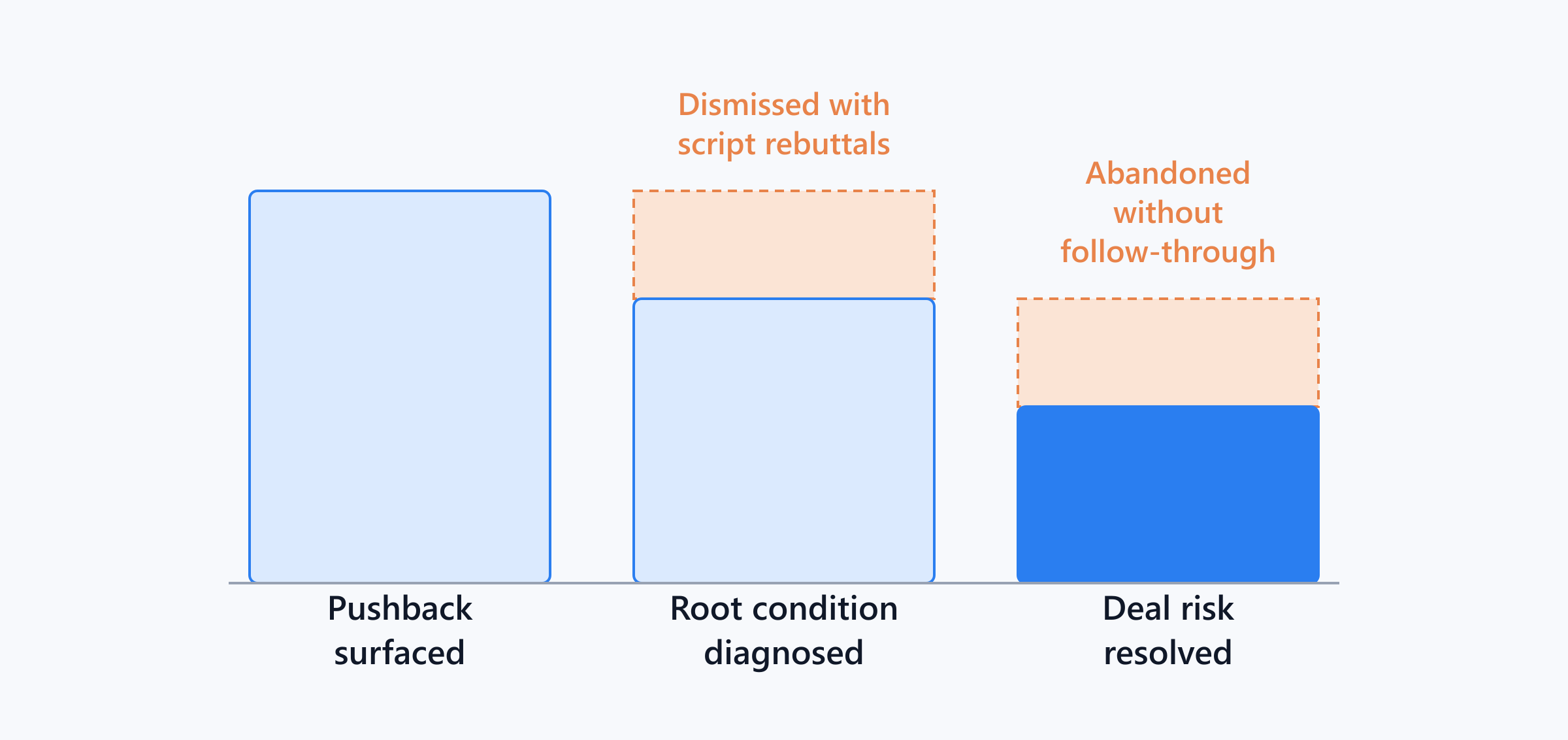
Objection handling is the rep's process for surfacing, understanding, addressing, and advancing a buyer concern that could delay, redirect, or stop a deal.
For sales operations, a useful objection handling definition must cover the entire process. A rebuttal is only one possible response, and often the wrong first move. The rep must find the condition behind the pushback before deciding what information, proof, stakeholder, or next step is needed.
An objection is evidence of unresolved risk or uncertainty. It is not automatically a rejection.
Handling quality and deal outcome are separate measures. A rep might acknowledge a security concern, identify the control under review, provide the relevant documentation, and schedule a meeting with the security team. The execution can be sound while the concern remains open until that team approves it.
A polished answer measures rep execution. A resolved concern measures deal progress. Store them separately.
Not every concern can or should be overcome during the call. Some require technical validation, procurement approval, revised terms, or a stakeholder decision. This operating model focuses on categorization and tracking, rather than building another script library.
What counts as an objection, and what does not?
An objection expresses a condition, concern, or perceived risk that must be resolved before the buyer is willing or able to proceed.
The phrase alone is not enough. Managers need the buyer's meaning, the consequence for the deal, and the surrounding call context.
| Buyer moment | Log it as an objection when | Otherwise log it as |
|---|---|---|
| A question such as, 'Does the platform support SAML?' | The buyer says the answer will affect approval or willingness to proceed. | A question or discovery point. |
| A request such as, 'Send your security documentation.' | The request reflects a security, credibility, or approval concern that blocks progress. | A routine follow-up request. |
| A stall such as, 'Send me some information.' | Follow-up questions uncover an underlying concern about price, timing, fit, competition, or trust. | An unqualified stall or next-step request. |
| A capability request such as, 'We would like a HubSpot integration.' | The buyer frames the missing or uncertain capability as a reason the deal cannot proceed. | A preference, requirement to validate, or discovery note. |
| A condition such as, 'We cannot sign unless data can stay in our tenant.' | The condition directly controls approval or purchase. | An objection, categorized according to the confirmed root concern. |
No single phrase always indicates a specific objection type. 'That is expensive' could mean the budget is unavailable, the buyer does not see enough value, or a competitor quoted less. The rep needs to ask what makes the price difficult before assigning the category.
Use the buyer's exact or near-exact words as the source record. Attach the call timestamp or recording link so managers can inspect the moment instead of relying on the rep's post-call memory.
The 5 types of deal pushback to categorize
These five types of sales objections cover distinct sources of deal risk. The classification should reflect the confirmed root concern, not the first noun the buyer used.
| Primary type | Classification rule | Realistic buyer wording |
|---|---|---|
| Price | Use for concerns about cost, available budget, commercial terms, or whether the expected value justifies the spend. | 'The annual fee is above the budget finance approved, and we cannot make the payback case yet.' |
| Competition | Use when the buyer compares the offer with an incumbent, a named rival, another approach, or the option of doing nothing. | 'Our current vendor already covers most of this, so switching would need a clear operational benefit.' |
| Feature | Use when a required capability, integration, workflow, or technical fit is missing, uncertain, or unproven. | 'If the data cannot sync both ways with HubSpot, our operations team will not approve the rollout.' |
| Timing | Use for concerns about urgency, implementation windows, contract dates, competing priorities, or a stated reason to defer. | 'The implementation window has closed. The earliest we could start is after the ERP migration in Q1.' |
| Trust | Use for concerns about credibility, proof, security, reliability, change risk, promised outcomes, or confidence in the seller or company. | 'Before we move forward, our security team needs evidence that customer data is isolated and access is controlled.' |
Keep price separate from feature fit and trust. If the buyer accepts that the product can do the job but cannot justify the spend, classify it as price. If the buyer doubts a required workflow exists, use feature. If the capability is claimed but the buyer does not believe it will work reliably, the root concern is trust.
Use one primary type per objection.
Add a secondary type only when the buyer explicitly raises two distinct concerns. If the buyer says the budget is frozen and security has not accepted the data controls, timing or price might be primary and trust secondary, depending on the immediate blocker. Create separate records when the concerns have different owners, statuses, or next steps.
Multiple tags do not repair a vague note. Diagnose first, then classify.
How to log an objection in the CRM
Good objection tracking in CRM requires enough context to support coaching and pipeline inspection without turning the rep's notes into a transcript rewrite.
The following is a recommended operating model, not a universal set of required CRM fields.
| Field | What to record |
|---|---|
| Primary objection type | Price, competition, feature, timing, or trust. Add a secondary type only under the classification rule above. |
| Buyer wording | The exact or near-exact statement that shows the condition, concern, or risk. |
| Root concern | What the rep confirmed through follow-up questions, such as an unavailable budget, a required integration, or security approval. |
| Call context | Call date, account, deal stage, rep, and the timestamp or recording link where the objection occurred. |
| Handling quality | An assessment based on the team's coaching rubric, kept separate from whether the buyer's concern was resolved. |
| Resolution status | One of the defined statuses below, applied according to what the buyer confirmed. |
| Owner and due date | The person responsible and the date by which follow-up must happen. |
| Next step | The specific action needed to move the concern forward, including any required stakeholder or decision. |
Recommended objection resolution statuses
- Unaddressed: The concern was raised, but the rep did not acknowledge or investigate it.
- Explored: The rep asked diagnostic questions and clarified the root concern, but has not yet given a response.
- Addressed but open: The rep responded, but the buyer has not confirmed that the concern is cleared.
- Resolved: The buyer confirmed that the condition was satisfied or evidence shows the blocker was removed.
- Deferred to a defined next step: Resolution depends on a scheduled action, named owner, due date, or future decision event.
Each objection resolution status should answer what happened, rather than how confident the rep feels. Sending collateral does not resolve an objection by itself.
Suppose a buyer says the fee exceeds the approved budget. The rep clarifies the budget cycle and required scope, then agrees to prepare a revised commercial option for finance. Handling may be strong, but the status remains addressed but open. The owner is the account executive, and the next step is a live review of the revised option by the agreed due date.
A note that says only 'pricing concern' cannot support inspection. It omits what the buyer meant, whether the rep diagnosed it, whether the issue remains open, and who owns the next move.
If your team wants to capture objection type, handling quality, and resolution status from every tracked sales call without relying on rep memory, Contexro captures typed objections across reps and links timestamped key moments to the recording.
How leaders use objection data to coach and inspect deals
Counts alone are weak.
Review objection mix by rep, team, segment, deal stage, and period. A concentration of timing objections might show weak urgency, poor qualification, a segment with fixed buying windows, or a real change in market priorities. Compare similar deal contexts before treating the pattern as a rep problem.
The same rule applies across categories. Recurring feature objections can point to a discovery gap, unclear positioning, missing proof, or product feedback. Repeated trust objections should trigger inspection of security, implementation, customer proof, reliability, and seller credibility.
Compare handling quality with resolution status before praising the response. A rep may handle a price objection calmly and ask the right diagnostic questions, while the buyer still needs CFO approval. The behavior can be strong while the deal risk remains open.
The reverse also matters. An internal sponsor might clear the concern after a poor call, but the rep still needs coaching if they interrupted the buyer, guessed at the cause, or failed to confirm the next step.
A practical coaching rubric
This checklist is a management model, not a validated universal scoring standard. Adapt the criteria to your sales process and buyer context.
| Check | What good looks like |
|---|---|
| Acknowledge | The rep recognizes the concern without dismissing it, arguing, or rushing into a prepared answer. |
| Diagnose | The rep asks a relevant question that identifies the condition, consequence, stakeholder, or evidence behind the pushback. |
| Respond | The response addresses the confirmed concern with relevant information, proof, options, or a clear limit. |
| Confirm | The rep checks the buyer's view instead of assuming the response worked. |
| Advance | If the concern remains open, the rep creates a next step with an owner, due date, and required participant. |
Inspect each check before compressing performance into a broad average. For a deeper treatment of blended scoring, read Your sales call scorecard is averaging away the thing you need to see.
Context changes the right response. An early-stage buyer asking about price may need scope and value clarified before a useful estimate is possible. A late-stage buyer facing a fixed procurement cap needs a discussion about terms, scope, approval, or timing. Both are price objections, but coaching them with the same script would miss the actual job.
Build an objection-handling library from original call moments. Organize examples by category, stage, buyer context, handling quality, and outcome. A real example should show what the buyer said, what the rep asked, how the buyer reacted, and what happened next.
A simple weekly objection review for sales leaders
This is a suggested management routine, not a benchmark. Its value depends on consistent definitions and accurate records.
- Review new and unresolved objections. Look at the most common categories and the concerns that remain open, rather than reporting total objection volume alone.
- Find ownerless risk. Identify deals where an open objection has no owner, due date, or defined next step.
- Choose one coaching focus. Select one recurring category and one call example that demonstrates the behavior the team should repeat or correct.
- Route underlying patterns. Send repeated feature, proof, security, positioning, or implementation issues to the team responsible for fixing the source.
- Preserve the taxonomy. Use the same classification rules each week so changes over time represent buyer behavior, not shifting manager judgment.
Keep the definitions fixed.
If a category repeatedly creates disagreement, update the written classification rule and give managers a clear example. Do not quietly let each manager invent a local meaning.
What to do next
Start by defining the five categories and resolution statuses in plain language. Add the recommended CRM fields, then have managers classify the same recent call moments independently. Resolve disagreements before using the data for coaching or pipeline inspection.
Only then automate.
For the product workflow, read Objection Handling in Sales: How Contexro Finds Deal Risk.