How Contexro Upgrades Call Center QA With AI Analysis
Table of contents
- Manual sampling is not a quality assurance system
- What AI analysis should evaluate on every processed call
- Score the customer outcome separately from rep polish
- Turn objections and missing information into diagnosable QA patterns
- The QA workflow: from a processed call to a completed action
- Capture
- Evaluate and diagnose
- Coach
- Assign
- Manage
- A buyer checklist for upgrading call center quality assurance software
- See the workflow in Contexro
Useful call center quality assurance software evaluates every processed call against your checkpoints, separates rep technique from customer outcome, and assigns the resulting work.
The operating model is straightforward: capture the evidence, evaluate the call, diagnose patterns, then act.
Manual sampling is not a quality assurance system
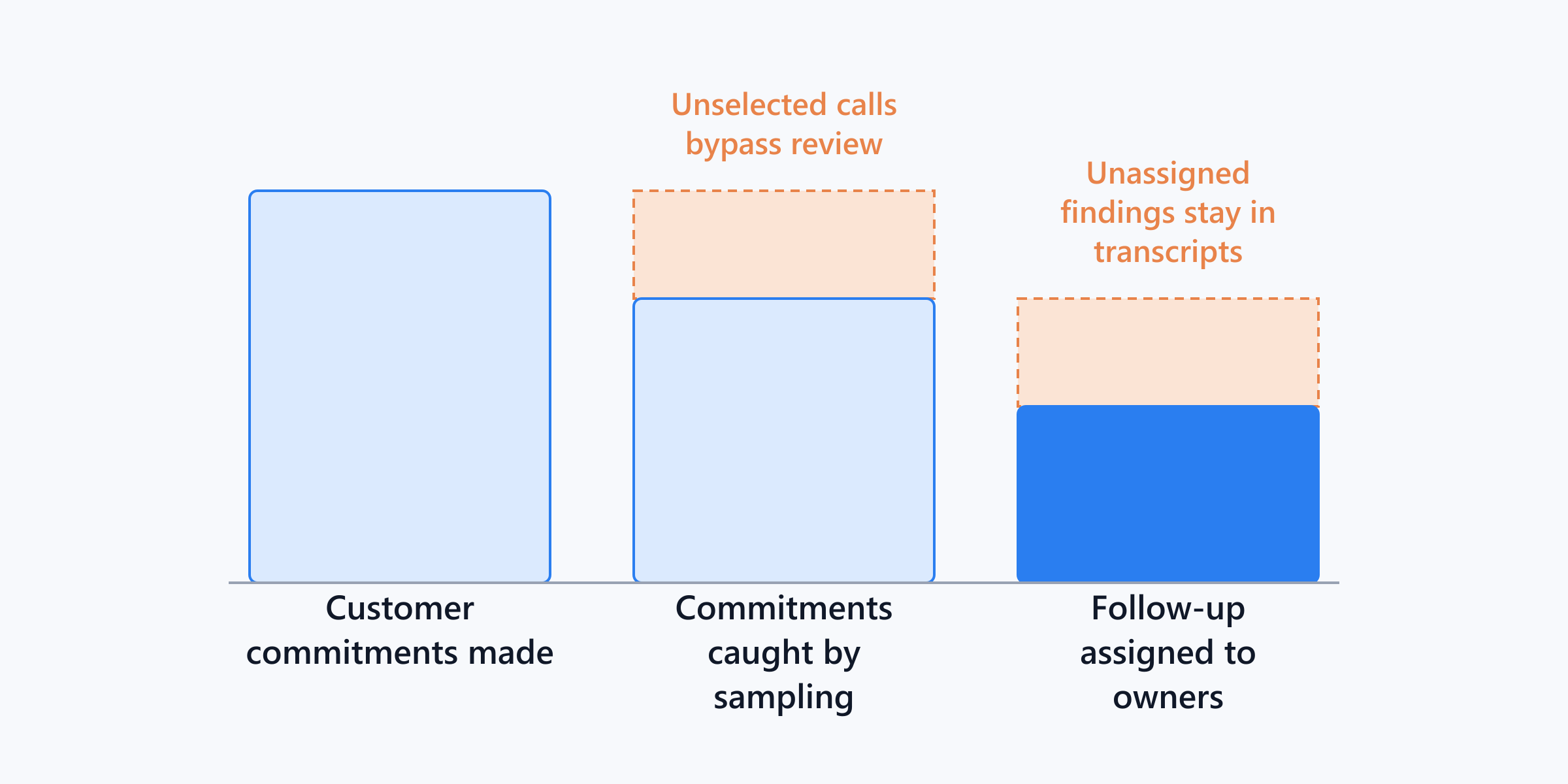
Manual review can catch a bad call. It cannot show whether the same issue keeps appearing across calls that nobody selected.
Review selection may miss recurring customer questions, weak listening habits, incomplete handoffs, and promised follow-up that never happened. A large recording archive in Gong, Chorus, Clari, or a contact center platform does not fix this by itself.
A single overall score creates another blind spot. It can hide whether the rep missed required information, handled the conversation poorly, left the customer unresolved, or failed to create the next task.
Four different failures should not collapse into one average.
The upgrade standard is consistent evaluation across every processed call, with evidence that reps and managers can verify and work they can assign. Otherwise, QA still ends in an unread transcript.
What AI analysis should evaluate on every processed call
Start with company-configurable checkpoints. The software should detect the value discussed, rather than merely marking the call as reviewed.
For a sales call, the checkpoints might be budget, timeline, and decision-maker. For support, a team could configure the affected feature, promised callback time, or required escalation detail.
Contexro captures configured business checkpoints with their detected values and lets managers filter the call list by whether each checkpoint was captured. A manager can see that a callback was promised for Friday afternoon instead of seeing a generic pass.
Sales leaders applying the same method to discovery can read What Are the 7 Steps of a Sales Call? Make Discovery Measurable.
Technique needs its own evaluation. Contexro scores rep technique across six Agent Score rubric dimensions, including communication, listening, objection handling, and commercial execution, with AI reasoning and the transcript moment behind each judgment.
Department scoring & coaching keeps separate scorecards for Sales, Support, and CS. The support team does not have to use the same scoring profile as the sales team.
Reasoning matters because a score alone cannot coach behavior. A manager needs to see that the rep interrupted the customer during the problem description, failed to confirm the issue, or explained the next step without checking understanding.
Conversation signals can help reviewers decide where to look. Sentiment trend, talk/listen ratio, silence, and longest monologue can surface calls that warrant attention, but no individual metric proves call quality or customer sentiment.
Verification should take seconds.
Speaker-labeled, timestamped transcripts with confidence scores establish who said what. Timestamped key moments link directly to the recording, so a reviewer can inspect the exchange without scrubbing through the entire call.
Score the customer outcome separately from rep polish
A courteous, well-structured call can still leave the customer without an answer, at risk of churn, or unsure what happens next.
A polished rep can still leave the customer unresolved. QA must show both facts.
Contexro uses Business Score as an independent outcome metric for customer experience, resolution effectiveness, churn risk, and deal impact. It is separate from Agent Score, which evaluates how the rep handled the conversation.
Consider a rep who listens carefully, restates the issue, and explains the troubleshooting steps clearly, but never confirms that service was restored. On an illustrative 10-point scale, the call might earn a 9 out of 10 for technique and a 4 out of 10 for customer outcome.
The reverse can happen. A rep may resolve the issue while delivering the explanation awkwardly, which creates a coaching need without creating the same customer risk.
| View | What it should answer | How a manager uses it |
|---|---|---|
| Rep technique | Did the rep communicate, listen, handle resistance, and execute the required process? | Coach the behavior shown in the evidence. |
| Customer outcome | Was the issue resolved, and what customer or business risk remains? | Prioritize follow-up based on the unresolved impact. |
The outcome score is a prioritization signal. It does not guarantee satisfaction, retention, resolution, or revenue.
The scoring failure behind blended averages is explored further in Your sales call scorecard is averaging away the thing you need to see.
Turn objections and missing information into diagnosable QA patterns
Generic objection handling is too broad to diagnose. Price, competition, feature, timing, and trust objections require different responses.
Objection intelligence classifies those categories, evaluates handling quality, and records resolution status across reps. This separates an objection the rep merely acknowledged from one the conversation actually advanced or resolved.
Acknowledged is not resolved.
Cross-rep scoring and benchmark comparisons then show whether the gap belongs to one rep or appears across the team. Phrase mining by stage can identify stronger responses, which managers can preserve in an objection-handling library.
The Competitor intelligence dashboard in Contexro uses alias-aware mention detection with context and sentiment, aggregated by period, trend, and department. It gives managers a place to inspect detected rival mentions without claiming that every spelling, alias, or indirect reference will be found.
Patterns also need customer context. Customer 360 provides a searchable customer list with Business Score categories, call history, red flags, filters, and a chronological timeline across every rep who spoke with that customer.
That timeline can reveal that a customer repeated the same unresolved feature question to three different reps. The issue is then a process gap, rather than three isolated call scores.
The QA workflow: from a processed call to a completed action
The value appears in the handoffs between analysis, coaching, and follow-up.
Capture
Contexro supports call sync from Freshcaller, RingCentral, HubSpot, and Talkdesk, plus manual and bulk upload. Supported connections provide automatic call and recording import with agent mapping.
Admins can analyze tracked lines, swap those lines from the admin console, and configure tracking per user or per line. A per-employee toggle provides another control over whose calls enter the process.
Long calls pass through chunked processing so content does not drop out. The AI Processing Pipeline analyzes the call after it has been processed and produces a structured report within minutes. It does not provide in-call prompting or live agent assist.
Evaluate and diagnose
The resulting Conversation IQ report summarizes purpose, outcome, and a TL;DR alongside scorecards, captured checkpoints, objections, key moments, and red flags.
A manager can start with the concise result, inspect the relevant score reasoning, and jump to the timestamped evidence. Full-text call search helps reviewers find related conversations when one call points to a wider issue.
Coach
After each processed call, Contexro provides 2-3 specific coaching tips in the rep dashboard and by email. They arrive within minutes, include the evidence behind the finding, and respect rep quiet hours.
This replaces quarterly coaching roulette with feedback tied to the call that created the need. The manager can still decide which behavior deserves a live coaching session.
How Contexro Turns a Sales Call Coaching Template Into Rep Behavior Change explains the same evidence-to-coaching method in a sales setting.
Assign
The rep promises to call the customer after engineering reviews the issue. That commitment can become a Work Item with an owner, due date, priority, comments, and board or list visibility.
Work Items can be AI-extracted from call touchpoints or created manually. Statuses such as Open, In Progress, Waiting on Customer, and Completed show what happened after the finding, without pretending to be CRM pipeline stages.
A manager should review extracted work before relying on it. No QA system should assume that every follow-up obligation can be inferred without human judgment.
Manage
Executive and team dashboards show score distributions and heatmaps. Daily and weekly email digests are scoped to each manager's reporting tree, and they surface overdue and due-today Work Items.
Missed and unanswered interactions belong in the quality picture too. The system reports missed versus answered calls by rep and week, and it surfaces unfollowed inbound voicemails where no later connected follow-up exists.
A manager can then assign the callback and enforce completion. Detection provides visibility; a person still owns the response.
Contexro keeps the sequence connected: the score points to evidence, the evidence supports coaching, and the finding can become an owned Work Item. Analysis no longer has to die in a transcript.
A buyer checklist for upgrading call center quality assurance software
Evaluate the operating model before comparing feature counts. The right controls depend on your call sources, QA process, access model, and reporting needs.
| Check | What good looks like |
|---|---|
| Coverage | Ask what counts as a processed call, which sources are shipped, and how the system handles tracked lines, long calls, missed interactions, voicemails, and uploaded recordings. |
| Configurability | Require checkpoints that reflect your own process and preserve detected values. Confirm that scoring history is versioned. A saved scoring prompt should apply to new and reprocessed analyses without silently recalculating all historical calls. |
| Explainability | Require distinct score dimensions, reasoning for each judgment, and direct links from findings to speaker-labeled, timestamped recording moments. |
| Outcome accountability | Confirm that customer experience and resolution effectiveness are evaluated independently from conversational polish. |
| Action follow-through | Verify that findings can become tasks with owners and due dates, that reps receive timely coaching, and that managers can see overdue work. |
| Governance and access | Validate tenant boundaries, tracking controls, exports, reporting, and sign-in requirements. Available controls include CSV and PDF exports, per-user or per-line configuration, and a per-employee tracking toggle. |
Data is tenant-only and never trains shared models. Embedded SSO lets your application sign already-provisioned users into Contexro inside an iframe. It is not SAML, OIDC, Okta or Azure AD federation, and the platform is not an identity provider.
These are evaluation criteria, not universal requirements. Test each one against the way your managers review calls and hold follow-up owners accountable.
See the workflow in Contexro
Support and QA teams should test the complete sequence with their own checkpoints: capture evidence, score technique and outcomes separately, diagnose recurring patterns, and assign the resulting work.
Healthcare-facing teams can see the same evidence model applied to unresolved issues in How Contexro Finds the Patient Questions Your Front Desk Cannot Answer.
See how Contexro evaluates every processed call against your checkpoints, separates customer outcomes from rep technique, and turns findings into owned follow-up work.