
How Contexro Replaces Sales Coaching Debates With Evidence
Table of contents
- The coaching debate that wastes the 1:1
- Use a timestamp, not a recollection, as the starting point
- Diagnose technique and outcome as two different questions
- Turn the agreed observation into one accountable coaching action
- A repeatable evidence-to-action agenda for every coaching 1:1
- When transcript evidence is most valuable
- What to do next
Evidence based sales coaching starts with the exact exchange, not either person's memory of it. Contexro takes a manager from a timestamped moment to separate Agent Score and Business Score signals, then to a linked Work Item with an owner and due date. The 1:1 stays focused on what happened, what it meant, and what the rep will practice next.
The coaching debate that wastes the 1:1
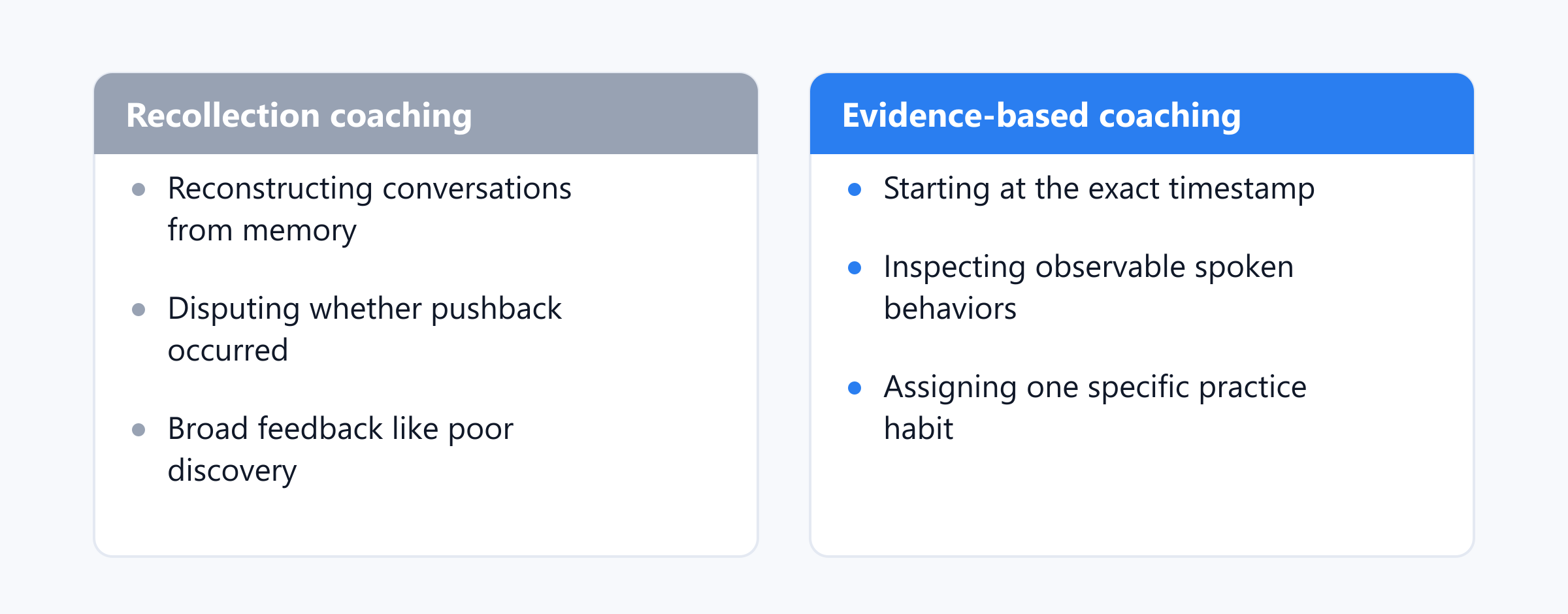
Consider an illustrative call. The buyer says implementation cannot begin until legal finishes its review, the rep acknowledges the comment, then moves straight into the demo.
The manager remembers a missed timing objection. The rep remembers a buyer who remained interested and agreed to another meeting. They spend the coaching session reconstructing the conversation instead of examining the behavior.
Broad feedback makes this worse. Labels such as "poor discovery," "you lost control," or "you talked too much" identify a concern without showing the rep what to change.
Usable feedback needs three parts:
- The moment: The exact exchange where the coaching issue appeared.
- The observed behavior: What the rep asked, said, avoided, or interrupted.
- The next behavior: A specific response the manager can look for on later calls.
If the manager cannot point to the exact exchange and name the next observable behavior, the feedback is still an opinion, even when the opinion is right.
Use a timestamp, not a recollection, as the starting point
Start with orientation. Contexro provides an AI-generated TL;DR and structured summary covering the purpose, narrative, and outcome of the call. The manager can then open a timestamped key moment that jumps directly to the corresponding point in the recording.
No full-call replay is required when the disputed moment is already identified.
Review the speaker-labeled, timestamped transcript and recording together. Ask what the buyer said, what the rep did next, and whether either person avoided or interrupted the issue.
In an illustrative review, the relevant moment might sit at 18:07. The buyer raises an implementation concern, the rep gives a long product explanation, and the buyer responds with silence before changing the subject. The timestamp makes that sequence available to both people.
The manager's opening question should be observational: "At this moment, what did the buyer say, and what did we do next?" That is more useful than opening with an accusation about poor handling.
Transcript based coaching can also use sentiment, conversation-phase awareness, talk ratio, silence, longest monologue, red flags, and positive signals. These signals tell the manager where to inspect. They do not decide whether the behavior was effective.
AI analysis is not infallible. Transcripts include confidence scores, and the recording remains available when wording or speaker attribution needs verification. A timestamp establishes where to look. It does not prove intent or replace managerial judgment about what good execution requires.
Diagnose technique and outcome as two different questions
Once the facts are clear, ask two questions separately:
- Technique: How well did the rep execute the controllable behavior?
- Outcome: What business result did the call produce?
Contexro's Agent Score assesses technique across six rubric dimensions, including clarity, listening, and commercial execution. The analysis includes reasoning and the transcript evidence behind the judgment.
Business Score is assigned independently. It assesses the outcome-related result, including areas such as resolution effectiveness and deal impact, without allowing a polished rep performance to hide an unresolved customer issue.
Neither score proves why an outcome occurred. A single call also does not establish a rep's normal performance. Read both as diagnostic signals that direct the manager back to the evidence.
The following matrix uses "stronger" and "weaker" as contextual manager judgments, not fixed product thresholds.
| Technique signal | Business result | Coaching response |
|---|---|---|
| Stronger | Unresolved or unfavorable | Inspect buyer context, persistence, and the next step. Good handling cannot force budget, timing, or internal approval. |
| Weaker | Favorable | Identify the execution gap before treating the call as a model. The buyer may have progressed despite the rep's behavior. |
| Weaker | Unresolved or unfavorable | Select one specific behavior for intervention rather than coaching the entire call at once. |
| Stronger | Favorable | Save the timestamped moment as a possible peer example, while keeping the customer context attached. |
Objections make the distinction concrete. Suppose a buyer says the proposed price will not pass finance this quarter. The rep clarifies whether the concern is available budget or expected value, confirms a next step, and still ends the call without commitment. The technique may be sound even though the business result remains unresolved.
The reverse also happens. A buyer might volunteer a procurement path and accept another meeting after the rep ignores a trust concern. A favorable next step does not erase the handling gap.
Typed objections provide specific sales coaching evidence for this review. Price, competition, feature, timing, and trust objections are categorized with their handling evaluated as addressed well, addressed poorly, or ignored, along with resolution status.
Turn the agreed observation into one accountable coaching action
Do not end with "be more consultative." Nobody can observe that instruction on the next call.
Define the behavior instead. For example: after a buyer states a budget concern, ask one follow-up question that separates budget availability from perceived value, then use that question on the next three qualifying calls.
In Contexro, the manager can create a Work Item from the AI analysis, a transcript line, a key moment, the call header, or an analysis section. The item can carry an owner, due date, priority, status, comments, and a deep link to the originating call moment.
The deep link matters. When the rep practices the behavior, both people can return to the evidence that produced the assignment rather than reinterpret the original feedback.
Review later calls for the behavior itself. Rep trends, goals, and progress tracking give the manager a place to examine whether it appears consistently. Assignment does not guarantee completion or improvement, so the manager still has to inspect the calls.
Reps also receive 2-3 specific tips after each processed call through the dashboard and email. The tips arrive within minutes and respect quiet hours. They supplement manager coaching; they do not decide which behavior deserves priority.
How Contexro Turns a Sales Call Coaching Template Into Rep Behavior Change shows the next stage: using goals and progress tracking to review the behavior after the diagnostic Work Item is set.
A repeatable evidence-to-action agenda for every coaching 1:1
- Before the meeting: Filter calls by outcome, scores, red flags, objections, customer timeline, and linked follow-up context. Select one or two moments where a decision, concern, or missed checkpoint warrants review.
- During the meeting: Open the exact timestamp and let the rep interpret it first. Compare the observed technique with the business result, then agree on one behavior to repeat or change.
- After the meeting: Create a due-dated Work Item linked to the evidence. Review subsequent calls for proof that the behavior was attempted, rather than closing the item from self-report alone.
Contexro's manager-scoped team views support the triage step, while Work Item tracking shows assigned, due-today, and overdue work. The system gathers the call evidence and keeps the follow-through visible. The manager still chooses the coaching priority and judges the rep's execution.
See how Contexro turns every recorded call into timestamped coaching evidence, separate technique and outcome scores, and assigned follow-through work.
When transcript evidence is most valuable
Start with calls where the observed technique and business result conflict. Those calls expose what a broad average can hide.
- Recurring objections: Review repeated price, timing, competition, feature, or trust concerns and compare how the rep handled each one.
- Discovery and qualification gaps: Inspect whether configured questions about budget, timeline, and decision-maker status were asked, missed, or volunteered by the buyer.
- New rep ramping: Use exact moments to show the expected behavior rather than relying on general advice.
- Repeated coaching disagreements: Compare the same behavior across multiple calls before deciding it is a pattern.
A talk ratio, silence period, monologue, or score is a prompt to inspect the conversation. None is a universal verdict. Context determines whether the rep was explaining a complex issue, listening to a detailed answer, or avoiding a necessary question.
Contexro supports question coverage templates, company-configurable checkpoints, custom metric extraction, scorecards, and rep benchmark comparisons. Managers can use those tools to define what they want to inspect without treating every metric as a mandate.
If an average hides the split between execution and outcome, Your sales call scorecard is averaging away the thing you need to see explains why aggregate scores need a call-level check.
To make discovery checkpoints observable, use What Are the 7 Steps of a Sales Call? Make Discovery Measurable.
What to do next
Pick one disputed call. Open the summary, find the timestamp, let the rep interpret the exchange, and evaluate technique separately from the business result.
Then assign one observable behavior as a linked Work Item. On later calls, inspect whether that behavior appears. That is the full evidence-to-action loop.
Start free for 1 month with 1 track line and 199 minutes. No credit card required.